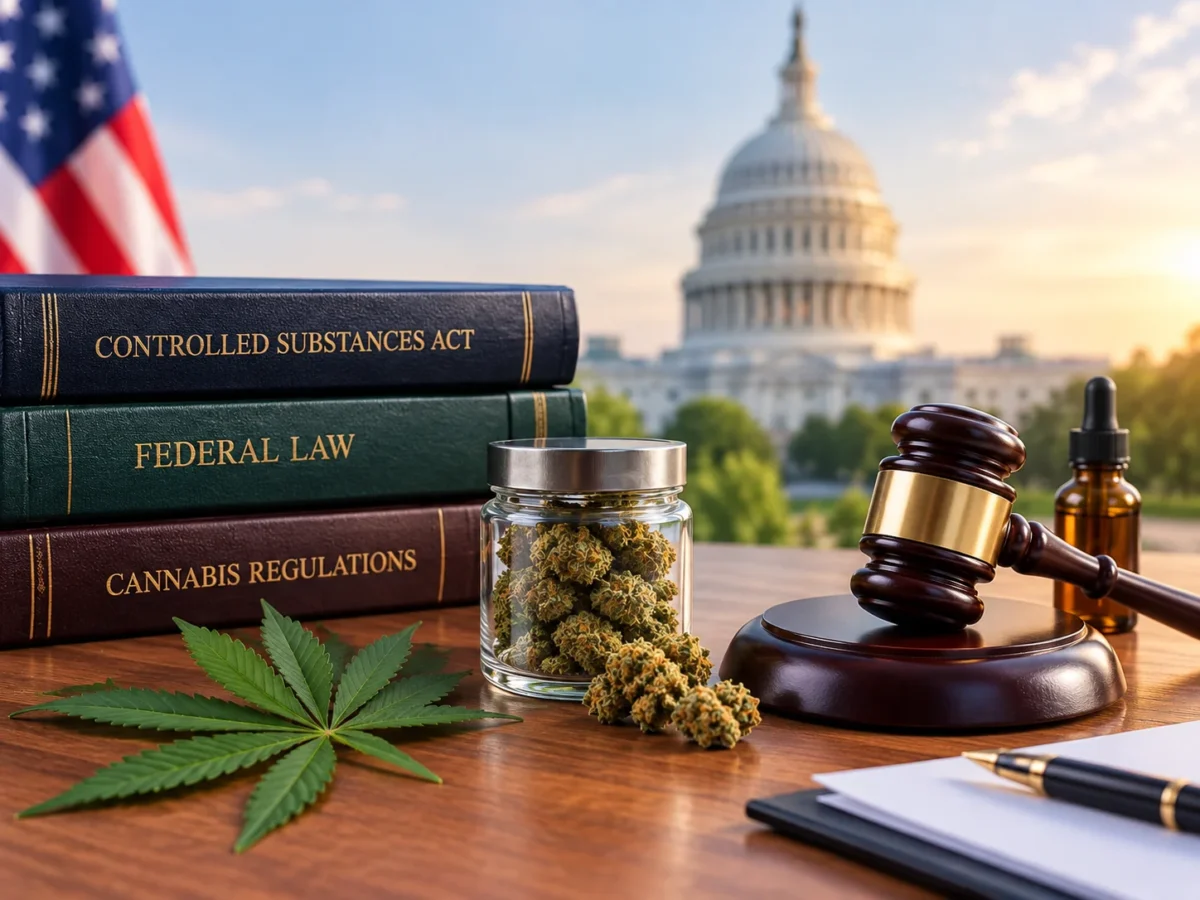
Cannabis Rescheduling is the re-classification of cannabis under the CSA (Controlled Substances Act) of the U.S. federal government.
Marijuana has been included in Schedule I, which is the most restrictive schedule under the federal CSA, for decades. In 2023, the Department of Health and Human Services of the United States (HHS) proposed moving marijuana from Schedule I to Schedule III based on a medical and scientific assessment of marijuana.
An HHS recommendation does not necessarily mean that marijuana would become legalized at the federal level or even become legal in all states.
The process of federal rescheduling has developed quite a lot since then.
Specifically, in April 2026, the Department of Justice and DEA classified certain FDA-approved marijuana products and marijuana products produced according to state medical marijuana license as Schedule III. At the same time, the process of Cannabis Rescheduling was restarted by the government.
This is an important aspect when talking about the Schedule III and its implications for consumers and businesses.
Why did HHS recommend Schedule III?
HHS made its recommendations based on a scientific and medical evaluation carried out at the federal level.
The evaluation looked into various requirements of the Controlled Substances Act, including:
- The possibility of abuse of marijuana
- Physical and psychological dependence
- Medical use
- Scientific evidence
- Safety data
- Public health concerns
Based on this, HHS found that marijuana needed to be rescheduled from Schedule I to Schedule III.
This recommendation was significant because Schedule III drugs were subject to different federal laws than Schedule I drugs. However, this reclassification does not mean the creation of federally legal recreational cannabis use.
The original report by the HHS also included evidence for various diseases, such as chronic pain, nausea and vomiting related to chemotherapy and appetite loss due to certain diseases. In addition, there is differentiation between areas with more evidence and those with less evidence.
What Was Included in the HHS Report on Medical Use?
Whether marijuana has any current medically accepted use was one of the primary concerns of the HHS analysis.
The report referred to evidence from clinical trials, systematic reviews, and other scientific sources.
For instance, HHS referred to evidence related to:
Chronic Pain
Evidence on the use of Cannabis Rescheduling and cannabinoid products for chronic pain was referenced by HHS along with the National Academies of Sciences, Engineering, and Medicine and others.
The evidence was different when it came to various types of cannabis. HHS pointed out the difference between whole-plant cannabis, inhaled cannabis, cannabinoid medicines, and others.
Chemotherapy-Related Nausea and Vomiting
Nausea and vomiting related to cancer chemotherapy have been studied for cannabinoid medicines. It was one of the medical uses considered by the federal government.
Appetite and Anorexia
Evidence related to appetite stimulation and anorexia related to certain diseases was also evaluated by HHS.
It was one of the factors behind the recommendation to schedule marijuana as Schedule III. These findings should not be seen as evidence of effectiveness for all conditions and for all types of Cannabis Rescheduling.
What Has Happened After the Initial Recommendation?
Here lies the divergence from the scenario provided in the original 2024 article.
The recommendation of the 2023 HHS was followed by a DEA proposal in May 2024 to reclassify marijuana from Schedule I to Schedule III. According to the proposal, marijuana would still be under federal regulations despite the rescheduling being completed.
The administration procedure was prolonged.
In 2026, the U.S. Government adopted a new strategy.
On April 28, 2026, a final rule scheduled FDA-approved marijuana products as well as marijuana products licensed by qualifying state medical marijuana programs into Schedule III. This rule also included an expedited DEA registration process for qualifying state medical marijuana enterprises.
This step, however, did not schedule all marijuana into Schedule III.
The broader proposal stands alone in a separate federal proceeding.
What Difference Would Schedule III Make To Cannabis Enterprises?
Rescheduling of Marijuana will affect one of the topics that people often consider as regards the effect on marijuana businesses.
Marijuana businesses that operate according to state regulations have always had a unique federal tax situation since marijuana has always been classified as Schedule I controlled substances.
According to the federal tax law, the Internal Revenue Code, Section 280E prohibits any deduction for businesses involved in trafficking of Schedule I and Schedule II controlled substances.
When marijuana becomes rescheduled to Schedule III, Section 280E will no longer be applicable to marijuana businesses just by virtue of being rescheduled to Schedule III.
How Will Rescheduling of Marijuana Affect Section 280E?
What About Section 280E and Cannabis Taxation?
Section 280E is one of the key factors that makes rescheduling discussion relevant for the cannabis industry.
According to present-day regulations in the US, Section 280E generally bars deductions for expenses related to the trafficking of Schedule I or II controlled substances for businesses dealing with them.
In case of marijuana firms, it includes:
- Employee salaries
- Lease fees
- Marketing expenses
- Professional services
- Administrative expenses
- and other regular expenses
Rescheduling marijuana to Schedule III may have a significant impact on the applicability of Section 280E to cannabis-related businesses.
However, the precise tax implications depend on the exact scope and timing of the final rulemaking process.
That is one more reason why it is crucial to make the difference between the action to be taken by April 2026, which relates exclusively to limited medical marijuana, and Cannabis Rescheduling.
Is It Possible to Expand Research Through Cannabis Rescheduling?
Research is also a key problem.
Traditionally, scientists studying marijuana have faced federal controlled-substances legislation making research more difficult.
Schedule III is still a controlled substance, but its regulation differs significantly from Schedule I.
Both HHS’s initial recommendation and federal actions afterwards focused on the possible connection between scheduling and scientific research. As mentioned in April 2026, the DOJ explicitly stated its narrow Schedule III decision to encourage medical research.
Further research may aid scientists in comprehending:
- Cannabinoid pharmacology
- Medical efficacy
- Potential adverse effects
- Drugs interaction
- Safety concerns
- Dosage issues
- Various formulations of Cannabis Rescheduling
- Medical cannabis use in certain populations
Nevertheless, Cannabis Rescheduling will not remove research legislation completely.
Scientists will have to comply with various regulations, including applicable federal legislation, institutional policies, clinical trial guidelines, among others.
What Could It Mean for Medical Marijuana Programs?
The impact on patients may be slower than some reports have indicated.
The state medical marijuana program would not become obsolete just because marijuana is between federal schedules.
The states continue to regulate cannabis on their own.
In fact, the April 2026 federal rule was especially about marijuana that falls within state medical marijuana licensing and provided a streamlined registration process for those businesses.
Medical marijuana patients would still be affected by such aspects as:
- State patient eligibility criteria
- Requirements for physician certification
- Patient registration
- Possession limits
- Regulations on products
- Requirements for dispensaries
- State testing standards
In other words, federal scheduling and state medical marijuana programs are connected yet different regulatory regimes.
But What About Recreational Cannabis Markets?
There could be a greater complexity in relation to recreational marijuana.
A general Schedule III categorization will not necessarily legalize recreational marijuana at the federal level.
According to the DEA’s own proposal, moving marijuana to Schedule III did not imply a full exemption from federal criminal prohibitions against marijuana.
This implies that any recreational cannabis market operating under the jurisdiction of different states may still be subject to both federal and state laws.
State governments may decide:
- If adult-use marijuana is legal
- Who can buy marijuana
- Where marijuana can be sold
- Licensing issues
- Cannabis possession limit
- Product testing
- Adverting ban
Consequently, the Cannabis Rescheduling must not be confused with federal legalization.
What Cannabis Rescheduling Will Not Do
Here are some common myths associated with Schedule III.
1. It Would Not Automatically Legalize Recreational Marijuana
Schedule III is a schedule for controlled substances.
An action at Schedule III level will not mean getting rid of marijuana under the Controlled Substances Act.
2. It Would Not Instantly Unite All Cannabis Markets in the US
Cannabis state legislation will still apply.
A business in California, Michigan, Florida, or any other state would have to follow the rules for cannabis of this particular state.
3. It Would Not Automatically Get all Cannabis Products FDA Approved
FDA approval is an entirely different matter.
Schedule III classification does not necessarily imply the evaluation and FDA approval of a flower, edibles, vape juice, oil, or any other type of Cannabis Rescheduling.
Current Status of Cannabis Rescheduling
Currently, as of September 30, 2026, there are two main processes at the federal level.
Firstly, some FDA-approved marijuana drugs and marijuana drugs under qualifying medical marijuana licenses of states have been scheduled under Schedule III since April 28, 2026.
Secondly, the DEA continues its own separate proceeding regarding rescheduling of marijuana.
The DEA conducted evidentiary hearings on June 29-July 15, 2026. As reported in a legal analysis dated September 24, 2026, the hearing has been completed, and the post-hearing briefs have been submitted. At the moment of the above analysis, the recommendation of the administrative law judge was pending; then, the final decision was to be made by the DEA Administrator.
Therefore, the current status is much more complicated than stating “rescheduling of marijuana.”
Some marijuana products are already listed in Schedule III, but not all marijuana is scheduled yet.
FAQs about Cannabis Rescheduling
Is marijuana currently classified in Schedule III?
Yes, some of it is. As per the DEA final rule of April 2026, FDA-approved marijuana products, and marijuana products covered by qualifying state medical marijuana licenses have been put in Schedule III.
Has HHS rescheduled marijuana?
No. HHS made recommendation for Schedule III following its scientific and medical review of the matter. The scheduling process belongs to DEA and the Department of Justice.
Would Schedule III legalization cannabis at the federal level?
No. Schedule III classification is still a controlled substance classification. Rescheduling doesn’t lead to automatic nationwide legalization of Cannabis Rescheduling for recreational use.
Can cannabis businesses get benefits through amendments in Section 280E?
It depends. In case of transfer of marijuana to Schedule III, there can be impact on the interpretation of Section 280E. This is because Section 280E applies to trafficking of Schedule I or II controlled substances.
Will Cannabis Rescheduling research become easy?
Potentially yes, although Schedule III rescheduling of marijuana would not make research any more exempt from federal rules.
Final Thoughts
In this case, the Cannabis Rescheduling story has developed significantly further from its initial start back in 2023.
In particular, HHS recommended rescheduling to Schedule III on the basis of a review of scientific and medical information. Later on, the DEA would propose rescheduling to an even higher degree, and the overall process went through hearing and other administrative actions.
In addition, as of April 2026, the government took a more limited but significant step in placing certain FDA approved marijuana products as well as state-licensed medical marijuana products meeting certain qualifications in Schedule III.
Get Your Medical Marijuana Card
Stay informed about changing Cannabis Rescheduling laws and get professional guidance for your medical marijuana needs in San Diego.
>>Start Your Online Evaluation<<
Resources
- HHS — Basis for the Recommendation to Reschedule Marijuana into Schedule III
HHS Marijuana Rescheduling Recommendation - DEA — Marijuana Rescheduling Regulatory Actions
DEA Marijuana Rescheduling Regulatory Actions - U.S. Department of Justice — Medical Marijuana Placed in Schedule III
DOJ: Medical Marijuana and Schedule III - DEA — Hearing on Proposed Marijuana Rescheduling
DEA: 2026 Marijuana Rescheduling Hearing - Federal Register — Schedule III Medical Marijuana Rule
Federal Register: Schedule III Medical Marijuana Rule