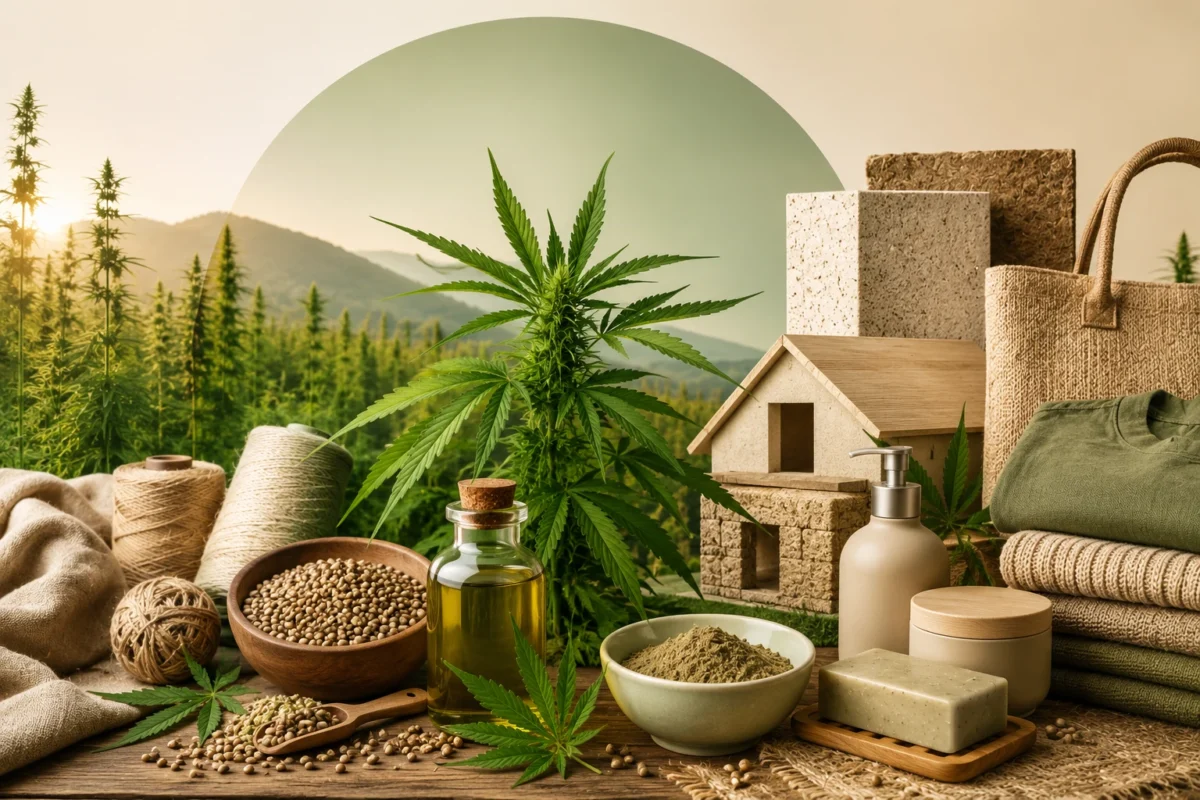
National Hemp Month is a perfect occasion to delve deeper into the amazing world of one of the world’s most versatile plants. Hemp has a long tradition of being used in food, fiber, textile, building materials, and other applications. The rising awareness of sustainable materials and hemp-based products has once again placed hemp in the center of attention.
In the course of National Hemp Month, people get an opportunity to learn more about the agricultural value of hemp, products based on hemp, and innovation which further expands the applicability of this amazing plant.
Despite being frequently mentioned along with cannabis, hemp should be viewed separately because these concepts have different legal definitions in the U.S. federal legislation. According to it, hemp means all parts or derivations of Cannabis sativa L., which have no more than 0.3% delta-9 THC in dry weight basis.
From food to fibers, National Hemp Month is the perfect occasion to appreciate the versatility of hemp.
What makes hemp unique?
Hemp is one of the Cannabis sativa plants; however, federal law classifies hemp separately from marijuana largely depending on the level of delta-9 THC in it.
According to the USDA, hemp is classified as Cannabis sativa L. and all its components having less than 0.3% delta-9 THC on a dry-weight basis.
It became possible due to such separation to generate many chances for farmers, producers, researchers and businesses, who are interested in creating hemp products.
One of the most interesting aspects of hemp is that different parts of the plant may be used for different purposes. For instance:
- The seeds can be utilized in food products;
- The fiber can be made into textiles;
- The stalk material can be used for industrial purposes;
- Hemp compounds can be analyzed for different purposes.
During National Hemp Month, the use of all these opportunities helps to discover hemp without common stereotypes.
A Brief History of Hemp
Hemp has been used by humans for thousands of years.
In the past, the hemp plant was appreciated for its strength and versatility. Its fibers could be made into rope, cloth, and other items. Hemp seeds were also eaten.
The U.S. history of hemp has been through many changes since the beginning. The 2018 Farm Bill set out the definition of hemp at the federal level and gave guidelines for its growth, with the USDA overseeing the production programs for hemp.
Nowadays, there is National Hemp Month that allows to reflect upon the past of hemp as well as the emerging industries related to it.
National Hemp Month and Modern Hemp Culture
Contemporary fascination with hemp is more than just rope and cloth.
The following uses of hemp are under consideration by businesses:
- Clothing and textiles
- Nutrition and food
- Skin and body care items
- Construction materials
- Paper substitutes
- Industrial materials
- Research and development
This increased diversification highlights the importance of National Hemp Month to those with an interest in agriculture, sustainability, innovation, and cannabis education.
Additionally, hemp provides consumers with the chance to learn more about plant utilization across various industries.
Hemp as a Healthy Food Source
Hemp seeds have been gaining popularity as ingredients for foods like smoothies, cereals, snacks, and plant-based meals.
According to the FDA, some hemp seed-based ingredients may be used in food under appropriate safety and manufacturing conditions. It should be noted that hemp seeds themselves do not contain THC or CBD, but these substances may be added due to contact with other hemp parts during harvesting and processing.
Hemp seed-based food products can give a lot of nutrients like:
- Proteins
- Healthy fats
- Fibers
- Minerals
These food products may be easily included in various meals without significantly modifying the recipe.
In celebration of National Hemp Month, you may try your hand at cooking a hemp seed-based recipe in order to learn more about using hemp in food.
Popular choices are the following:
- Smoothies
- Yogurt
- Salads
- Oatmeal
- Homemade energy bars
- Plant-based meals
Hemp Fiber and Sustainable Products
One of the more well-known ways to use hemp is in the production of fiber.
Hemp fibers can be manufactured into various materials, from textiles to industrial products. The interest in environmentally friendly and renewable materials has also spurred research into alternative fibers.
Alternative products from hemp can include:
- Apparel
- Bags
- Ropes
- Papers
- Insulations
- Composites
- Other industrial uses
Such developments may be some of the reasons why National Hemp Month may attract those who are interested in innovation for sustainability.
Nevertheless, all claims regarding sustainability should always be scrutinized carefully, since the ecological footprint of any crop or product depends on many factors – from farming through manufacturing.
Hemp and Innovation
Hemp is not seen merely as an agricultural product anymore.
The scientists and producers still find new applications for hemp fibers, hemp seeds, and other plant parts.
Possible innovative areas may include:
Textile industry
The fibers from hemp can be used in the production of clothes and textiles that will last for years.
Building Materials
Some construction and insulating materials based on hemp are researched now.
Food Industry
Hemp seeds as an ingredient are used more often in food products.
Industrial Uses
The fibers extracted from plants can be used in the production of materials intended to decrease the use of some conventional materials.
That diversity makes National Hemp Month an event combining traditions and innovations.
Understanding Hemp-Derived CBD
CBD is one of the most frequently talked-about components when it comes to hemp.
Nonetheless, CBD from hemp should not always be assumed to be a proven remedy for all types of health problems.
The FDA says that the agency has approved one prescription CBD medication to treat specific forms of seizures, but not other CBD products to treat any diseases or conditions.
The FDA has also warned against potential dangers of some CBD products in terms of safety issues, possible interaction with medications, and false medical claims.
Therefore, National Hemp Month may also be a great time to promote responsible cannabis and hemp education.
It is important to exercise caution regarding products that promise to cure severe diseases.
Fun Ways to Celebrate National Hemp Month
It is not necessary for you to be a hemp grower or an expert within the industry in order to take part in National Hemp Month.
Here are some easy ideas:
1. Try a Recipe Using Hemp Seeds
Incorporate hemp seeds into your smoothie, salad, or breakfast dish.
2. Discover Hemp Products
Seek out products containing hemp fiber, such as clothing, accessories, and home goods.
3. Research Hemp Farming
Educate yourself on the process of hemp farming and how farmers engage in regulatory farming programs.
Information about hemp farming and research can be found from the USDA.
4. Provide Accurate Information
Clear up confusion by providing accurate information about the differences that exist between hemp.
5. Learn about Hemp Agri-Business
Keep up-to-date on advancements in hemp farming, manufacturing, nutrition, and cannabis research.
The Future of Hemp
The future of hemp will undoubtedly involve innovation, research, and regulation.
Given that companies are looking for novel materials and consumers are becoming more interested in using plant-based materials, hemp may find applications in various industries in the coming years.
However, sustainable development necessitates proper labeling, product standards, scientific research, and consumer education.
The FDA keeps researching and answering various questions about cannabis extracts, such as CBD, while facilitating research and regulations in regard to products with medical applications.
National Hemp Month is a good chance to praise the opportunities offered by hemp and understand the significance of information.
Celebrating Hemp With Knowledge and Curiosity
The history of hemp starts from being a material used agriculturally to becoming an interest of today’s food industry, textile sector, manufacturing, and science.
The best possible way to observe National Hemp Month is to get interested in the crop and be informed enough.
Check out a hemp product. Use hemp seeds in your recipe. Know more about those who cultivate hemp. Understand the difference between proven facts and advertising. Be up-to-date with science.
In the world of growing interest in sustainable materials and innovations that are based on plants, National Hemp Month is still a nice reminder of what a single plant can give us.
Frequently Asked Questions
What Is National Hemp Month?
National Hemp Month is an occasion that enables people to celebrate and learn about hemp and its history, agricultural significance, edible qualities, fiber capabilities, and potential role in contemporary industries.
Is hemp the same as marijuana?
Although hemp and marijuana belong to the cannabis plant genus, according to federal legislation, hemp can be legally distinguished by the amount of THC it contains. By the USDA definition, industrial hemp must contain no more than 0.3% delta-9 THC on a dry weight basis.
Can you consume hemp seeds?
Yes, hemp seeds-derived products may be incorporated into a wide range of foods provided that these products are manufactured and marketed in compliance with relevant regulations.
Do all hemp plants have CBD?
The levels of various compounds vary between different hemp plants and hemp-derived products. Hemp seeds do not contain THC or CBD.
Are all CBD products FDA-approved?
There is only one prescription CBD product that the FDA has approved for treating specific seizures.
Resources
USDA Hemp Research and Extension
https://www.nifa.usda.gov/hemp-research-extension-faq
FDA Cannabis and Cannabis-Derived Products
USDA Hemp Laws and Regulations
https://www.ams.usda.gov/rules-regulations/hemp