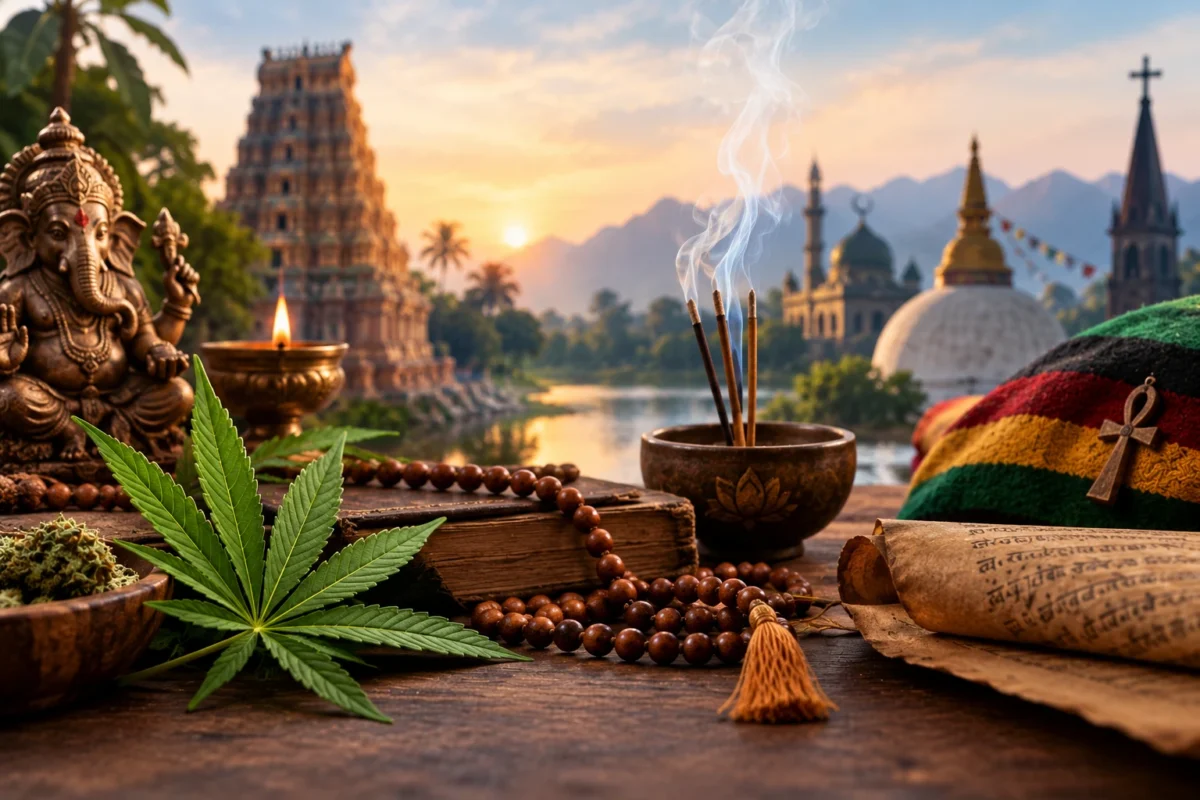
Short answer: Religions that embrace cannabis are not all part of one belief system. Some traditions have historical connections with cannabis through ceremonies, medicine, meditation, or sacred practices, while modern cannabis-centered religions may treat the plant as a sacrament. Hindu traditions and Rastafari are among the best-known examples, while archaeological research has also found evidence of ritual Embrace Cannabis use in ancient China and Judah.
The discussion about cannabis is currently focused on medicine, recreational usage, legalization, and culture. But spirituality’s connection to the plant has a long history.
People have used various plants for centuries during their ceremonies, healing procedures, meditation, and religious rituals. Embrace Cannabis is just another example of those plants.
This aspect of cannabis usage makes the issue even more interesting since there are some religions in which cannabis is embraced by people. In some of them, cannabis is linked to specific gods or ceremonies, while others use cannabis during spiritual gatherings. Some modern religions have incorporated Embrace Cannabis into their system of beliefs as well.
It should be mentioned, though, that not all followers of the religion which embraces cannabis use it, nor does cannabis have to be a mandatory element of the faith.
Some researchers have shown that cannabis was historically used for spiritual purposes and explored the way modern cannabis users define it as an entheogen in the Journal of Cannabis Research.
Then, what does it mean when a religion embraces cannabis?
What Does It Mean When a Religion Embraces Cannabis?
“Religions that Embrace Cannabis” may refer to a number of different things.
For instance, cannabis might be used in well-known religious rituals. It might also have cultural and historical importance without being a part of the religion itself.
Another option is spiritual sects that purposely consider cannabis sacred.
That is why all examples cannot be classified as one single group.
Cannabis has been linked to:
- Religious rituals
- Meditation and contemplation
- Healing practices
- Group events
- Spiritual contemplation
- Offerings
- Altered state of consciousness
- Culture
A 2020 study about Embrace Cannabis use found out that 25% of the survey participants admitted having spiritual motivations for using cannabis. Furthermore, it was discovered that spiritually motivated people perceived their cannabis experiences in a different way than recreational users.
It does not mean that Embrace Cannabis causes religious experiences for all people. It simply demonstrates that some people perceive their experiences through a spiritual lens.
Hindu Traditions and Cannabis
When considering religions that practice the use of Embrace Cannabis, it is common to refer to Hindu practices, due to the association between cannabis and practices in India.
One of the most famous examples is bhang, which is an old preparation of cannabis that has been used by people in some regions of India for centuries.
Cannabis is also associated with Shiva in some Hindu traditions. Various sources show connections between Shiva and cannabis preparations; however, Hinduism itself is highly diverse.
This is a crucial point to mention.
Hinduism is not a religion, according to which all its followers must use cannabis. There are millions of Hindus who lead their religious life without using cannabis at all.
This way, Embrace Cannabis is a part of the tradition in certain cultures.
What Is Bhang?
Bhang is traditionally made from the leaves of the Embrace Cannabis plant and other ingredients, and it can be taken in the form of either drinks or food preparations.
It has traditionally been linked to particular religious festivals and cultural activities in India.
Scholarly studies on cannabis in different cultures state that cannabis has a long tradition in Indian culture and traditions and has been linked to Shiva and Ayurveda.
The history further makes it clear that Embrace Cannabis cannot be dissociated entirely from the culture in which it is used.
For some people, the bhang has religious significance while for others, it is a tradition.
Rastafari and the Spirituality of Ganja
Rastafari is yet another excellent example to analyze when discussing religions that use cannabis.
Rastafari religion emerged in Jamaica in the 20th century and combines cultural, social, philosophical, and religious beliefs related to Africa, Ethiopia, Biblical interpretation, and spiritual freedom.
In some Rastafari groups, ganja plays the part of a sacred herb.
The herb can be consumed during reasoning meetings where people discuss spirituality, social matters, personal experience, and religious beliefs.
For people who believe that ganja is a sacrament, cannabis is more than just an item of consumption for fun; its significance is related to spirituality and community.
Scientific studies of cannabis as an entheogen recognize Rastafari religion as one of those religious movements where cannabis may become a sacrament.
Is Cannabis Necessary for Rastafari?
Not really.
There are many different groups within Rastafari, so each of them may believe differently.
It is a good note to keep in mind when talking about religions that use cannabis as part of their tradition, because acknowledging that there is a long-standing link between a religion and cannabis doesn’t automatically imply that everyone practicing that religion is using cannabis as well.
Cannabis in Ancient China
The link between cannabis and spirituality goes beyond new religious movements.
Archaeologists have uncovered indications that cannabis was used ritually in ancient China.
According to the Journal of Cannabis Research, there is evidence of ritual use of cannabis in China going back about 2,500 years.
This is important because it shows that people did not necessarily only use cannabis for pragmatic reasons.
There was a much wider universe of plants, medicine, burial customs, rituals, and beliefs in which cannabis was situated.
Nevertheless, when we consider ancient evidence, we must be careful not to make assumptions based on the presence of cannabis at an archaeological site.
Indications of Cannabis in Ancient Judah
Another interesting example is found in the ancient Kingdom of Judah.
Research by archaeologists has uncovered the presence of cannabis residue in an ancient shrine of the people of Judah, suggesting that the use of cannabis was possibly included in a ritual setting around the eighth century BC.
What makes this find particularly interesting is that it offers physical proof rather than just information contained in written texts at a later period.
However, it would be misleading to interpret this finding as meaning that Judaism is a religion which welcomes cannabis.
The finding is relevant to an ancient historical context, not to modern Judaism, which has many traditions and interpretations.
Why Is This Discovery Important?
It contributes to the knowledge of the use of psychoactive and aromatic plants by ancient civilizations.
It further proves that the Embrace Cannabis plant was culturally significant not only in South Asia but elsewhere as well.
Therefore, the history of cannabis and spirituality goes well beyond the boundaries of one particular religious tradition or region.
Cannabis and Ancient Eurasian Rituals
Hemp has been used in the historical descriptions of some of the ancient inhabitants of the Eurasian steppe.
The ancient Greek historian Herodotus wrote about a ceremonial use of hemp by the Scythians, and this is a commonly cited example when historians talk about ceremonial use of Embrace Cannabis.
These historical descriptions are fascinating since they imply that cannabis can be used ceremonially in societies that have evolved separately from religions in South Asia.
However, at the same time, historians should be careful about ancient descriptions.
Herodotus was describing customs of people who belonged to different cultures, and ancient written texts may include some misunderstanding and exaggeration.
Therefore, ancient texts become really useful only in connection with archaeological findings and other information.
Are There Modern Religions Based on Cannabis?
Yes.
Modern times have witnessed the establishment of religious institutions where cannabis occupies a significant spiritual role.
Certain groups were formed in the 20th and 21st centuries because Embrace Cannabis laws, counterculture, spirituality, and freedom of religion became more closely linked to each other.
Examples of such religious groups include the First Church of Cannabis, a religious group that was created in Indiana and sees cannabis as a sacrament in their religion.
Cannabis-based religions are distinct from traditional religions such as Hinduism and Rastafari.
They emerged in modern societies, and in their ideology, they tend to incorporate spiritual concepts along with those of personal freedom, peace, community, and responsible use of cannabis.
Why Do Modern Cannabis Religions Differ from Other Religions?
The historical tradition may develop a link with Embrace Cannabis over many years.
The modern-day cannabis religion, on the other hand, may actively include cannabis into its religious identity.
This fact is crucial in considering religions that involve cannabis.
There isn’t a single understanding of what the “sacred cannabis” means.
Cannabis and Contemporary Spirituality
Cannabis is also used in non-religious ways.
There are individuals who do not affiliate with any formal religion but use cannabis within the context of meditation, introspection, spirituality, and other practices.
Academics have identified a group of cannabis users who describe their experience with cannabis in a spiritual manner.
For these individuals, cannabis may be associated with:
- Self-reflection
- Meditation
- Creativity
- Emotional exploration
- Feeling of connection
- Nature
- Personal spirituality
It does not necessarily turn their practice into a religion.
On the contrary, it is one more example of how modern spirituality can be highly individual.
Why Cannabis Means Different Things to Different People
One of the key things to learn from the study of religions which accept cannabis use is that there is no single, universal symbolism behind this plant.
The same cannabis plant may be understood as:
Sacrament:
Religious group might venerate cannabis plant and consume it as part of their spiritual ceremonies.
Traditional preparation:
There are traditional and religious aspects of bhang, for example, in some parts of India.
Medicinal plant:
Cannabis was used within traditional healing.
Symbol of culture:
In some cultures, cannabis is seen as a symbol of identity, history, or even struggle.
Personal spiritual tool:
Some users of cannabis use it as part of their meditation and reflection practices.
Recreational drug:
Many consumers of cannabis do not see anything spiritual or religious in it.
It all depends on the context.
Does Cannabis Necessarily Produce Spiritual Experience?
Absolutely not!
This is a very crucial difference.
While a religion could regard cannabis as holy, this does not automatically mean that cannabis will necessarily lead to a spiritual experience for anyone.
According to the findings of the 2020 study on spiritual cannabis use, the majority of participants of this study did not regard cannabis as an entheogen. Some participants had spiritual motivations and experiences.
What it means that expectations, culture, religion, context, and experience of a person can affect the way cannabis is interpreted by him or her.
In other words, religions that accept cannabis create a cultural or religious framework for the interpretation of cannabis, not the universal experience.
Cannabis, Religion, and Modern Laws
Another significant component of the discussion is legality.
Sometimes, religious beliefs and the laws regarding cannabis are not consistent.
One may find that a certain community views cannabis as sacred, but the government in the region where it is situated regulates the usage of the substance.
These have led to legal disputes in many nations on topics such as religious freedom, illegal substances, and ceremonies.
The legal status of cannabis remains quite varied across the globe, and this must be taken into consideration when discussing religious usage of cannabis.
Religious significance does not give one a free pass legally.
Closing Remarks
The story of religions involving cannabis is actually more varied than one might expect at first glance.
Cannabis has had associations with religious groups in South Asia, with Rastafari spirituality, with ancient ritualistic practices, and with cannabis-centered modern religions. Scholars have also uncovered evidence to suggest that some modern cannabis consumers actively practice cannabis spiritually.
There is no such thing as a “religion of cannabis,” however.
Various communities have attributed different significance to cannabis, and many who follow religions involving cannabis do not partake of the drug themselves.
Resources
Cannabis as Entheogen: Spiritual Use of Cannabis
Journal of Cannabis Research – Springer Nature
Cannabis Use Across Cultures
Current Addiction Reports – Springer Nature
Cannabis and Spirituality Research
PubMed – National Library of Medicine