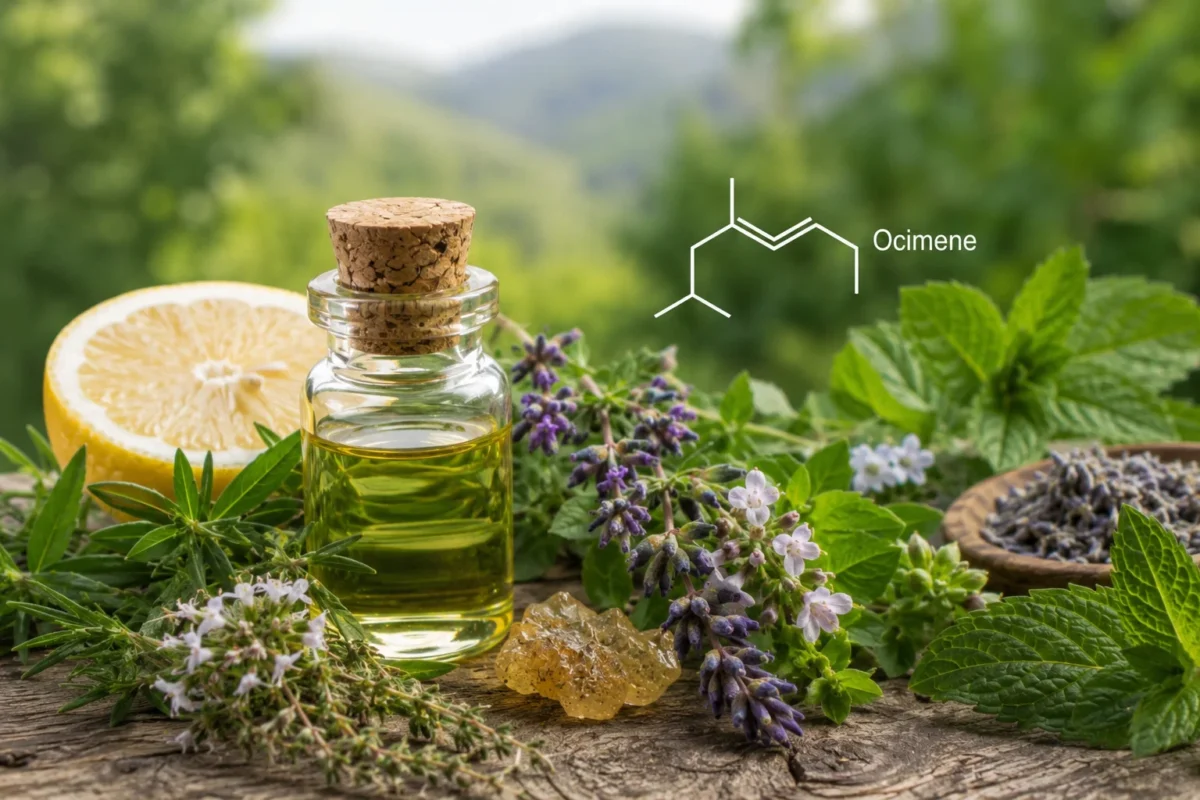
Ocimene Terpene is a natural plant compound that people know for its sweet smell, which is also a little bit herbal and sometimes smells like citrus. It is part of the monoterpene family, which’s a group of compounds that help plants have their own special smells.
The chemical makeup of ocimene is made up of C10H16. It weighs about 136.23 g/mol. There are types of ocimene, which are called isomers and these different types can make it hard to identify and study the compound.
In the cannabis plant ocimene is one of many chemicals that are present. Cannabis has a lot of terpenes which’re compounds that contribute to the plants smell and taste. Researchers have found ocimene in cannabis. It is one of the monoterpenes that they have reported.
Where Is Ocimene Found?
Ocimene Terpene is not found in cannabis. It is also found in other plants, flowers, herbs and essential oils.
This is one reason why scientistsre interested in ocimene. They want to know what role it plays in the plant world. Terpenes like ocimene can help plants interact with insects and other living things. Depending on the plant and the compound these chemicals can help attract pollinators or protect plants from animals and microbes that might try to harm them.
Because ocimene is found in many different plants researchers have to be careful when they are studying it. Just because ocimene does something in one plant it does not mean that it will do the thing in cannabis or, in people.
The Aroma and Flavor of Ocimene
One of the easiest ways to understand the Ocimene Terpene is through its sensory profile.
Ocimene is commonly associated with aromas that may be described as:
- Sweet
- Fresh
- Herbal
- Green
- Fruity
- Citrusy
- Woody
The exact scent can depend on the form of ocimene, its concentration, and the other aromatic compounds present alongside it.
This is important because cannabis aroma is rarely produced by one terpene alone. A flower or extract may contain a mixture of myrcene, limonene, pinene, caryophyllene, humulene, ocimene, and other volatile compounds. The final aroma comes from the overall chemical combination rather than a single ingredient.
Ocimene Terpene in Cannabis
The Ocimene Terpene can be present in cannabis, although its concentration varies between plants and products.
Analytical research has confirmed cis-β-ocimene among the terpenoids measured in both THC-dominant and CBD-dominant cannabis chemotypes. One study examining cannabis samples found cis-β-ocimene among the more prominent measured terpenoids, although terpene percentages differed between the chemotypes tested.
Other research has also shown that terpene concentrations can vary substantially, even among plants grown under controlled conditions. Genetics, cultivation conditions, harvesting, storage, and analytical methods can all influence the terpene profile measured in a cannabis sample.
For this reason, consumers should avoid assuming that every product sold under the same strain name will have an identical amount of ocimene.
Why Strain Names Are Not Enough
A strain name is a starting point it does not tell you exactly what is in the cannabis.
Research has shown that the chemicals in cannabis can vary a lot from one type to another.
This is a problem because it makes it hard to know what you are getting.
Scientists think that we need a way to understand how the genes of the plant how it is grown and the chemicals in it all work together.
When you can get the results from a laboratory and information about the terpenes that is more useful than just the name of the strain.
You can learn more about the things that make cannabis smell the way it does in an article about Cannabis Research and Modern Eye Care.
Potential Biological Properties of Ocimene
The Ocimene Terpene is interesting to scientists. We do not know much about what it does to people.
Some studies have looked at what terpenes can do. We have to be careful about what we learn from these studies.
There are kinds of studies such as:
- Laboratory findings
- Animal research
- Research on whole plants
- Studies on one compound
- Clinical evidence
These are all different and we cannot assume that what is true in one case is true in another.
Some scientists think that terpenes like Ocimene Terpene might be useful in fighting diseases. We need to do more research to know for sure.
So we cannot say that the Ocimene Terpene is a proven treatment for any condition.
The Ocimene Terpene and other terpenes are being studied,. We need more information before we can make any big claims about what they can do.
The Ocimene Terpene is one of many terpenes that are in cannabis and we need to learn more, about all of them.
Does the Ocimene Terpene Create an Entourage Effect?
The idea that cannabis compounds may interact with one another is often called the entourage effect.
Cannabis contains cannabinoids, terpenes, flavonoids, and other compounds. Researchers continue to investigate whether certain combinations can produce effects that differ from those of individual compounds.
Some experimental research has reported that cannabis terpenes can influence cannabinoid activity under specific laboratory conditions.
However, reviews of the scientific literature also point out that the evidence for specific entourage effects remains incomplete and sometimes conflicting. The exact role of an individual terpene, including ocimene, in human cannabis experiences is not yet fully established.
In simple terms, the entourage effect remains an active area of research—not a guarantee that a particular terpene combination will create a predictable result for every person.
The Ocimene Terpene and what it means for Cannabis Research
People are getting more interested in the Ocimene Terpene. That shows a big change in how we study cannabis. Now scientists are looking at cannabis as a plant with a lot of chemicals not just THC or CBD.
There are over a hundred terpenes in cannabis and scientists are still trying to figure out how they are made and what they do to the plant. The Ocimene Terpene is one of them.
We still need to learn more about the Ocimene Terpene. For example:
- How much Ocimene Terpene is usually in types of cannabis?
- What makes the plant produce less Ocimene Terpene?
- Does the Ocimene Terpene stay the same when we process and store cannabis?
- Is the Ocimene Terpene different when it is by itself or with cannabis extracts?
- Can we find out what the Ocimene Terpene really does to people?
We need to be careful and make sure we have evidence before we say anything, about the Ocimene Terpene. Until we have proof we should be careful what we say about it.