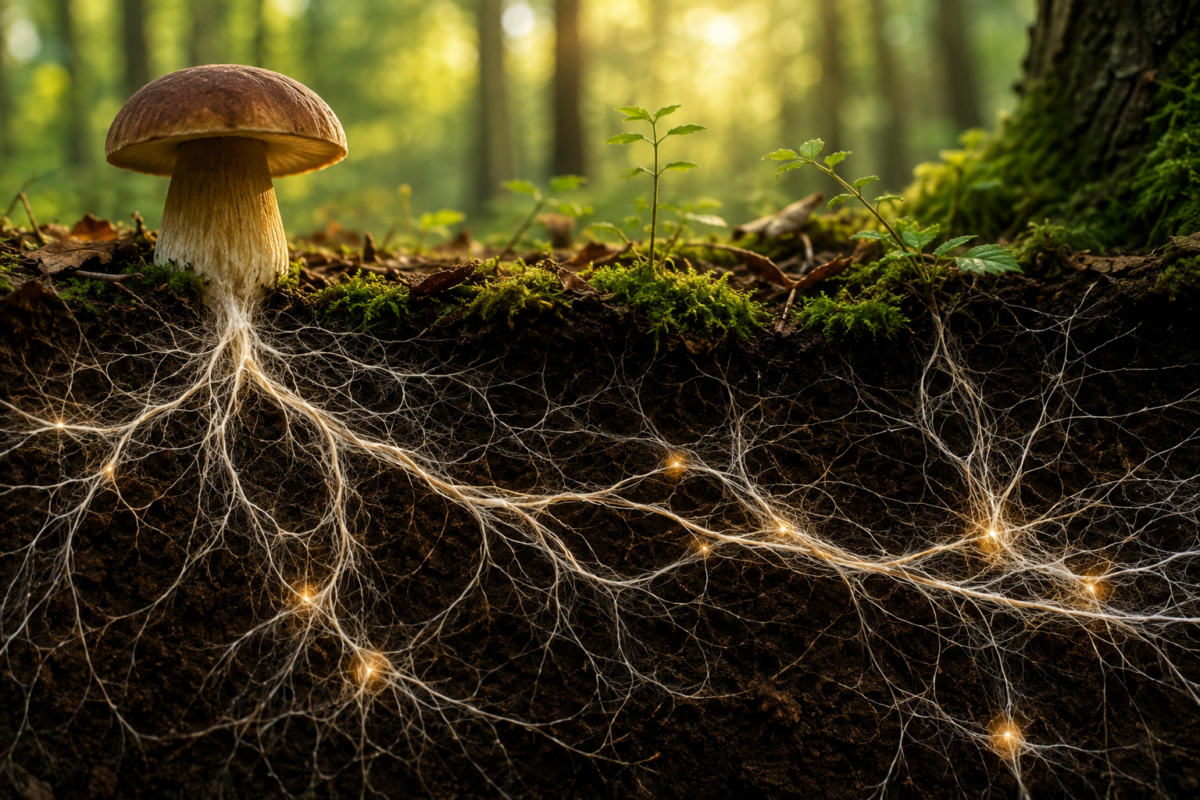
Fungi communication has become one of the most interesting topics in current studies of fungi. Underground, under the forest floor, on lawns, and in other environments, mushrooms develop networks of thin threads of hyphae. Hyphae together create mycelium, which is able to detect changes, transfer resources, and react to the environment.
The phenomenon of mushroom communication attracts a lot of attention from the audience. It is described by some experts as the underground internet, and there is also an assumption that mushrooms communicate with each other through electrical and chemical impulses.
However, the science is more complicated than some articles make it seem.
Scientists have a lot of evidence that proves the existence of biological interactions between fungi and plants. At the same time, scientists study electric activity in the mycelium. Still, speaking of a human-like language in fungi is still only an assumption.
In this article, we will consider what is known about the phenomena of mushroom communication, the mechanism of functioning of the mycelium, and open issues.
Table of Contents
- What is Mushroom Communication?
- Understanding Mycelium
- Communication of Fungi with the Environment
- Electrical Messages in Fungal Networks
- Mycorrhizal Networks and Plants
- Can Fungi Send Warning Signals?
- The “Wood Wide Web” Controversy
- Do Mushrooms Have a Language?
- Mushroom Communication and Ecosystem Health
- Can Mycelium Process Information?
- The Future of Mushroom Communication Studies
- FAQs
What is Mushroom Communication?
On a basic level, mushroom communication can be defined as the detection of information by fungi and the creation of biological response to it.
Fungi are in constant contact with the surrounding environment. It means that fungi are capable of reacting to such elements as humidity, nutrition, temperature, mechanical trauma, other living beings, etc.
These contacts are not always similar to human speech.
Sometimes the fungal communication is a complex process including the following elements:
- Chemical signals
- Electricity
- Movement of nutrients
- Growth responses
- Environmental stresses
- Interaction with plants and microorganisms
It is hard for scientists to determine which of these actions actually falls into the category of communication and which ones are something else. The thing is that sometimes people use too dramatic language when speaking about fungi.
Understanding Mycelium
The visible mushroom is only one aspect of a far bigger organism.
Most of the fungus is present in the form of mycelium. Mycelium refers to the presence of microscopic filaments, hyphae, which grow into soil, wood, leaves, and other substances.
These networks assist fungi in their process of nutrient absorption and exploration.
In some cases, mycelium can also interact with the roots of plants using mycorrhizae. This relationship is vital to many ecosystems.
Studies show that mycorrhizal fungi are present in the root zones of more than 90 percent of plant species, despite the differences in these interactions among various plants and types of fungi.
This interaction plays a crucial role in comprehending the communication processes of mushrooms.
Communication of Fungi with the Environment
Fungi are not inert organisms.
Fungi require constant sensing and reacting to changes in their surroundings. A fungus may come across a new source of nutrients, sustain mechanical damage, or be affected by the change in its access to water.
Chemical messages help fungi interact with other organisms.
Fungi can both release and react to chemical messages affecting their development and interaction with other living things. However, fungi developing mycorrhizal associations exchange molecular messages with plants while establishing the relationship.
This way, mushroom communication cannot only take place between fungi themselves.
The biological interactions of fungi include:
- Plants
- Bacteria
- Fungi
- Soil organisms
- Environment
Thus, the world underground should not be seen as a series of separate organisms but rather as an ever-changing ecological system.
Electrical Messages in Fungal Networks
One of the most fascinating aspects of the study of mushroom communication is electrically mediated signaling.
Electrical potential shifts have been identified within fungi, which can be manifested as spikes propagating along fungal structures.
It has been speculated that electrical signals can play a role in fungal coordination or transmission of messages between them.
But one of the key questions that scientists are asking is what meaning do these signals carry?
According to the recently published overview of electrical signaling in filamentous fungi, there are plenty of technical problems that scientists face when studying the topic.
Specifically, scientists need methods that would allow them to distinguish between meaningful biological signaling and physiological phenomena.
In other words, fungi definitely exhibit electric potential changes, but scientists have not proven yet that they have a similar “language” to that of humans.
This distinction is crucial for the discussion about mushroom communication.
Mycorrhizal Networks and Plants
Certain fungi establish associations with the roots of plants. This association is termed mycorrhizae.
A network of the fungus can sometimes link a number of plants, and thus the term common mycorrhizal network was coined by the scientists.
Scientists have examined the question of whether such networks might help the transport of nutrients and signaling between interconnected plants.
According to scientific reviews, there is some evidence that mycorrhizal networks can take part in the process of substance transfer and can affect the reactions of plants to herbivores, pathogens, and other stresses. Nevertheless, the nature of signaling molecules and control by the fungi still require additional research.
It is one of the reasons why mushroom communication is such a popular subject.
The fact that underground organisms can have an effect on the interactions occurring above the soil changes our view on ecosystems.
Can Fungi Send Warning Signals?
Consider a single plant being attacked by insects.
Could information of such an event affect the response of other plants, which are interconnected with each other through fungal networks?
This idea has been explored by scientists.
There is evidence that plants which are interconnected by fungal networks demonstrate changes in their responses to attacks when the neighboring plants are attacked. Various mechanisms of information transfer have been suggested; for example, movement of signals, nutrients, and chemical compounds via the common fungal network.
It does not mean, however, that fungi are sending messages in the same way as humans send alerts.
It is a highly complicated biological process.
Scientists have to figure out the following:
- What molecules are moving
- Which organism generates the signal
- Which organism gets it
- Whether the fungus controls the process or not
- How often do such processes take place in nature
It is just what makes studying mushroom communication fascinating.
The “Wood Wide Web” Controversy
“Wood Wide Web” is the term that is commonly used in regard to underground networks created by plant roots and fungi.
It is an evocative analogy; however, biologists have pointed out that the metaphor may be misleading when it comes to describing the biology.
Myccorrhizal networks definitely do exist. In addition, there is scientific evidence of the important role played by fungi in nutrient cycling and plant interactions.
The issue is in how exactly these networks work.
For instance, some accounts state that trees cooperate in some way through myccorrhizal networks and/or older trees systematically provide care for their young counterparts via such networks.
A recent article in Nature Plants described how the popular “wood-wide-web” metaphor might lead to unfounded assumptions.
The science behind fungi and tree networks is fascinating even without any human emotions being attributed to these organisms.
Do Mushrooms Have a Language?
The theory that the fungi had a vocabulary was widely popularized after experiments were conducted to measure electrical signals in fungi.
It was observed that clusters of electrical spikes could form patterns similar to those formed in human language.
Such an explanation has aroused great interest.
At present, there is no scientific opinion about the existence of a vocabulary or a language in the human sense in mushrooms.
The electric signals can serve a wide range of biological purposes.
In order to prove that the mushrooms communicate with each other, it is necessary to establish a direct correlation between the specific signal and its biological significance.
To put it in simple terms, researchers need to find proof that a certain signal is emitted on a certain occasion and leads to a certain reaction somewhere else in the network.
Till further research, it is safe to consider claims about literal mushroom conversations as speculations.
Mushroom Communication and Ecosystem Health
Despite the inability to prove that fungi possess language capabilities, the network of fungi is extremely valuable.
The role of fungi in ecosystems includes participation in the process of:
- Nutrient cycling
- Soil quality
- Plant development
- Carbon transport
- Decomposition
- Root formation
- Ecosystem resilience
Mycorrhizal associations assisted in developing successful symbiotic relations between plants and fungi for hundreds of millions of years. This interaction still plays an integral role in terrestrial ecosystems today.
Studying the process of mushrooms’ communication will provide scientists with more information about forests, agriculture, soil rehabilitation, and biodiversity.
Moreover, such research might result in discoveries related to environmental monitoring and biological computing.
Can Mycelium Process Information?
Scientists are also studying mycelium because there are several stimuli affecting the network of fungi.
While fungi are getting nutrients in one place, it might be harmed or affected by changes in another place.
It has to integrate its response into the network.
Fungal computing and bioelectrical properties have become the objects of studies in this area.
There were experiments on how the materials of the mycelial network react to electricity and environmental stimuli. There are scientists who believe that fungi could eventually contribute to unconventional computing and biologic sensing.
It does not mean that the fungus is thinking like computer or has some kind of human intellect.
Living networks are able to process environmental data in a special way, which inspires scientists for developing new technologies.
What Scientists Still Need to Discover
Mushroom communication studies are a new area of research.
Among the topics that might be solved by future research there can be the following ones:
What does the electricity of fungi mean?
It is important to link the electricity patterns with something biological.
How do the signals spread in fungi network?
One of the topics of interest is the way of spreading the signal – electrical impulse, chemical, structural or any other.
How frequently there is an interaction in mycorrhizal network?
Despite the fact that there is the possibility of physical connection of the plants, there is still the necessity to study how often the exchange occurs in nature.
Can the fungi recognize the environmental stimuli?
The reaction of fungi to the stimuli would give additional information about the coordination in fungi.
Can the fungal network serve as inspiration for technologies?
Perhaps the mycelium network would find the applications in future sensors, computing and responsive technologies.
The Future of Mushroom Communication Studies
Mushroom Communication is one area where science meets with imagination.
The network of connections made by fungi in the soil is quite real and amazing from a biological perspective. They communicate with the environment, form complicated connections with plants, and exhibit electrical activity.
At the same time, scientists still struggle to understand the meaning of many of these communications.
Perhaps the most intriguing thing about fungi studies is the abundance of unanswered questions.
With advancements in technology for observing fungi, scientists may find a whole new realm of biological interactions that redefine communication and intelligence.
For now, there is no need for fungi to talk in human ways for them to seem remarkable.
All the mystery of sensing, reacting, adjusting, and interacting happens under our very feet in the fungi’s networks.
FAQs
Do mushrooms talk to each other?
It is believed that mushrooms can exchange chemical and electric signals within their network. Nevertheless, scientists have yet to prove that fungi have a language similar to that of humans.
What is mycelium?
Mycelium is the network of fungal filaments that constitutes the body of the fungus. The mushroom that one can see is usually the reproductive part of this huge underground network.
Can mycelium connect plants?
Some mycorrhizal fungi can create a network that connects several plants. Scientists are trying to find out what is the effect of this phenomenon on the movement of nutrients and plants’ behavior.
Does the wood wide web exist?
Yes, mycorrhizal networks exist. Yet, there is still much debate regarding the rest of the assertions linked to this concept.
Do mushrooms have a language?
So far there is no scientific consensus about whether mushrooms have any words similar to those of people. Electric signals discovered by scientists are an interesting field of study but their exact purpose is still unknown.
Resources
- Electrical Signaling in Fungi: Past and Present Challenges —
Read the research review - Building Bridges: Mycelium-Mediated Plant-to-Plant Communication —Read the study
- Electrical Information Flows Across Fungal Sporocarps —
Read the Scientific Reports study - Communicate and Fuse: How Fungi Build Mycelial Networks —
Read the research article - Propagation of Electrical Signals by Fungi —
Read the study