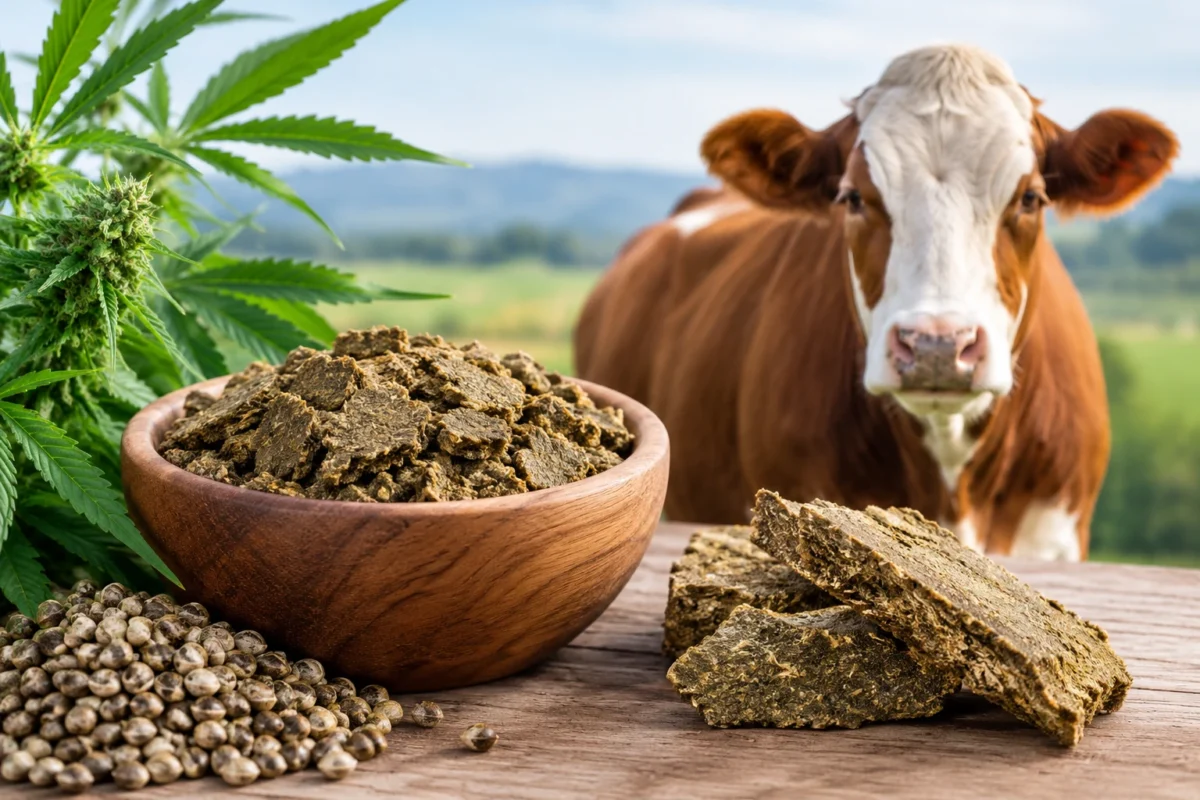
As scientists search for new opportunities of using byproducts of hemp in the field of livestock feeding, hemp cake for cattle becomes a fascinating subject to consider. Hempseed cake is the result of hemp seeds processing where oil is extracted; therefore, it is a source of protein, fibers, and other useful nutrients.
One critical aspect of this issue, however, needs to be considered: would the consumption of cannabis-related feed cause any cannabinoids to appear in the meat consumed by people?
Luckily enough, science provides several encouraging results: in the research when cattle was provided with hempseed cake, the presence of any cannabinoid residues in edible parts of cattle’s body turned out to be negligible.
What Is Hempseed Cake?
Hempseed cake is an end product made during hempseed oil extraction. Although the oil is extracted through mechanical methods, there can still be a significant amount of nutrients left in the seed.
Scientists have researched the use of hemp cakes for cattle due to the constant search for viable and nutritious sources of feed in animal farmers. It was found that there might be enough nutrients in the hempseed cake to make it suitable for use in ruminant diets.
The use of agricultural byproducts could also lead to creating a closed production process, since there would not be any wasted products but rather another source of productivity.
Growing Interest in Hemp Cake for Cattle
There has been an interest in hemp cake for cattle along with the growth in industrial hemp production.
Hempseed oil has various commercial applications; however, in the process of extraction of oil, there is always a significant amount of hempseed leftovers. It can present new possibilities for both the growers of industrial hemp and the livestock industry.
There has been research on the possibility of hemp cake for cattle as:
- A protein source
- A fiber source
- A substitute for some feedstock components
- Utilization of hempseed oil by-products
- A sustainable agriculture source
However, the main problem was food safety.
Due to the presence of cannabinoids in hemp, it was required to establish whether these substances (THC/CBD) can be found in the edible parts of cattle after eating the feed.
The Study on Hemp Cake for Cattle
A large-scale study done by scientists from the USDA Agricultural Research Service and North Dakota State University analyzed residues of cannabinoids in cattle which were being fed with hempseed cake.
In the experiment, crossbred heifers were being fed either a control diet or the same diet with 20% of hempseed cake based on dry matter content. The feeding period was 111 days and afterwards animals were slaughtered at various times following the cessation of consumption of hempseed cake.
The scientists studied the following edible organs:
- Skeletal muscle
- Liver
- Kidney
- Fat
The aim was to check whether cannabidiol and THC could stay in these organs if animals had consumed hempseed cake for a long time.
The experiment gave useful data regarding safety of the hemp cake consumption for cattle and transfer of cannabinoids along the food chain.
What Happened to THC and CBD?
The level of cannabinoids in the hempseed cake used for this study was extremely low.
As per the USDA, the concentration of CBD and THC in the hempseed cake was approximately 1.3 ± 0.8 mg/kg. The researchers pointed out that this level was far lower than the generally cited 0.3% THC limit, which is what constitutes industrial hemp in the US.
Throughout the feeding trial, there were instances where traces of cannabinoids were found in the blood and urine of the cattle.
However, just because something is detected in an animal’s system does not necessarily mean that it will stay in the meat that humans consume.
This point became even more relevant when researchers examined the edible tissues.
Did Cannabinoids Exist in Beef?
The results were promising; however, they need to be carefully interpreted.
Low amounts of the total CBD and THC compounds, roughly 10 parts per billion, were detected in the adipose tissue of cattle that had not undergone any withdrawal period.
On the other hand, CBD and THC were undetectable in:
- Skeletal muscle
- Liver
- Kidney
These results imply that there were no detectable cannabinoid residues in the edible tissues that are usually associated with lean beef in the case of this particular study.
It should be noted that not every kind of hemp products will yield similar results because the type of hemp feed, its concentration, level of administration, and time of exposure may differ.
Nevertheless, this study gave significant information on the use of hemp cake as cattle food.
Can Intoxication Occur From Consuming the Meat of Hemp-Fed Cattle?
This is possibly the question that consumers ask the most.
The scientists performed an exposure assessment to determine how much THC a human would take in from the consumption of fat from cows that were fed hempseed cake.
The result was that it would be almost impossible for a person to eat enough fat from such cows to exceed even conservative regulatory guidelines for dietary THC intake.
To put it in simpler words, eating meat from these cows on a regular basis would not intoxicate the consumers.
Such research is essential when talking about hemp cake for cattle, although it does not necessarily mean that all types of hemp animal feed should be approved right away.
Different types of hemp products contain different amounts of cannabinoids.
Hemp Cake and Animal Performance
Food safety is just one facet of the research.
For instance, scientists have examined whether the inclusion of hempseed cake in cow feeding has any influence on the growth, carcass features, and meat qualities of the animals.
According to a study with finishing heifers, the inclusion of hempseed cake did not have a notable negative impact on growth performance and carcass attributes under the given conditions.
Furthermore, according to another study with dairy cows, hempseed cake could replace soybean meal without notable negative impacts on animal performance and meat quality features.
In addition, research with veal calves has noted that hemp cake could serve as an interesting candidate feed ingredient for further study, but more research was required to define the optimal inclusion level.
All these studies indicate the importance of studying hemp cake for cattle.
Other Research Indicates the Importance of the Hemp Source
All hemp products are not created equally.
The composition of cannabinoids may vary from one hemp-based product to another. Therefore, the safety data obtained from one form of hemp product cannot simply be extended to another.
For instance, according to new research studies where industrial hemp inflorescence was administered to cows, residue concentrations of cannabinoids were found in some tissues and estimated depletion times were found to be much higher in certain tissues like adipose tissue.
It is necessary to remember this point.
The results of the study conducted over 111 days on hempseed cake relate only to low-cannabinoid hempseed cake. Such safety results cannot be extrapolated to all types of hemp-based livestock ingredients.
Important Differences Between Hemp and Hemp-Based Feed
While looking at the issues surrounding hemp cake for cows, there are aspects one must understand regarding how hemp products differ widely.
These aspects include:
- Portion of the hemp plant being processed
- Original cannabinoid content
- Processing process
- Amount being mixed in animal feed
- Feeding period
- Species of animals
- Withdrawal period before slaughter
This is just one of many reasons why further research is necessary.
The low-cannabinoid hempseed by-product will have an entirely different effect from that of the high-cannabinoid flower and leaves of hemp plants.
Regulatory Considerations for Hemp Cake for Cattle
While promising results have been found through scientific studies, science is not synonymous with regulatory approval.
The USDA has clarified that it will be up to the U.S. Food and Drug Administration to make the final determination on the legality of using any hemp byproducts in animal feed.
The 2023 USDA report indicated that hempseed cake was not legally approved for inclusion in food-animal rations when the study took place.
There are many things to take into consideration before a new feed ingredient can be approved. For example:
- Health of the animals
- Safety for consumers
- Chemical residues
- Feeding levels
- Withdrawal times
- Uniformity of the hemp byproducts
Further research might provide regulators with the information necessary to make an informed decision.
Can Hemp Byproducts Make Agriculture More Sustainable?
Another possible benefit of using hemp cake as livestock feed is in terms of agriculture efficiency.
A large amount of a by-product is generated during the production of hemp seed oil. The utilization of such by-product as animal feed might help to decrease the level of waste and increase the value of the crop.
Hemp seed cake has been suggested as a protein and fiber source and a potential substitute to other components of feed as well.
Nevertheless, any sustainability claims should be proved by more thorough research.
The sustainability of the hemp feed production will depend on several aspects, such as growing process, transportations, processing, land use, and ingredients that may be replaced by hemp cake.
The Future of Hemp Cake for Cattle
Hemp cake as a feed supplement for cattle in the future will largely depend on ongoing research and evaluation.
The current research has shown the following positive observations:
- Low-cannabinoid hempseed cake has potential from a nutritional point of view.
- No significant adverse effects were found on cattle productivity under certain experimental conditions.
- Cannabinoids in muscles, liver, and kidney were found at a level lower than the detection limit in the major 111-day study.
- Exposure assessments showed that consumption of meat from the experimentally fed cattle would not lead to THC exposure.
- Agricultural by-products could become a new way of livestock feeding.
At the same time, there is a need to evaluate other hemp products, dosing of feeding, animal species, and long-term outcomes.
Conclusion
Hemp cake for cattle is a unique combination of agricultural products based on cannabis plants, animal nutrition, and food safety.
The research on the use of low-cannabinoid hempseed cake for 111 days by the cattle showed satisfactory results. There was no detection of CBD and THC in the skeletal muscle, liver, and kidney of the animals. Only the lowest amounts of THC could be found in fat right after the end of consumption.
This shows the possibility to use selected low-cannabinoid hempseed products in the form of cattle feed.
Nevertheless, hemp cake for cattle is still a relatively new research field. Different types of hemp can result in the development of a different residue pattern. Regulatory approval is one of the significant factors for defining the possible application of the ingredients in the process of food-animal production.
Concluding, the results of the scientific research look quite promising.
References
USDA: Cannabinoid Residues in Cattle Fed Hempseed Cake
Read the ResourceExcretion and Residue Depletion of Cannabinoids in Beef Cattle Fed Hempseed Cake for 111 Days
Read the Research StudyHempseed Cake and Cattle Growth Performance
Read the Research Study