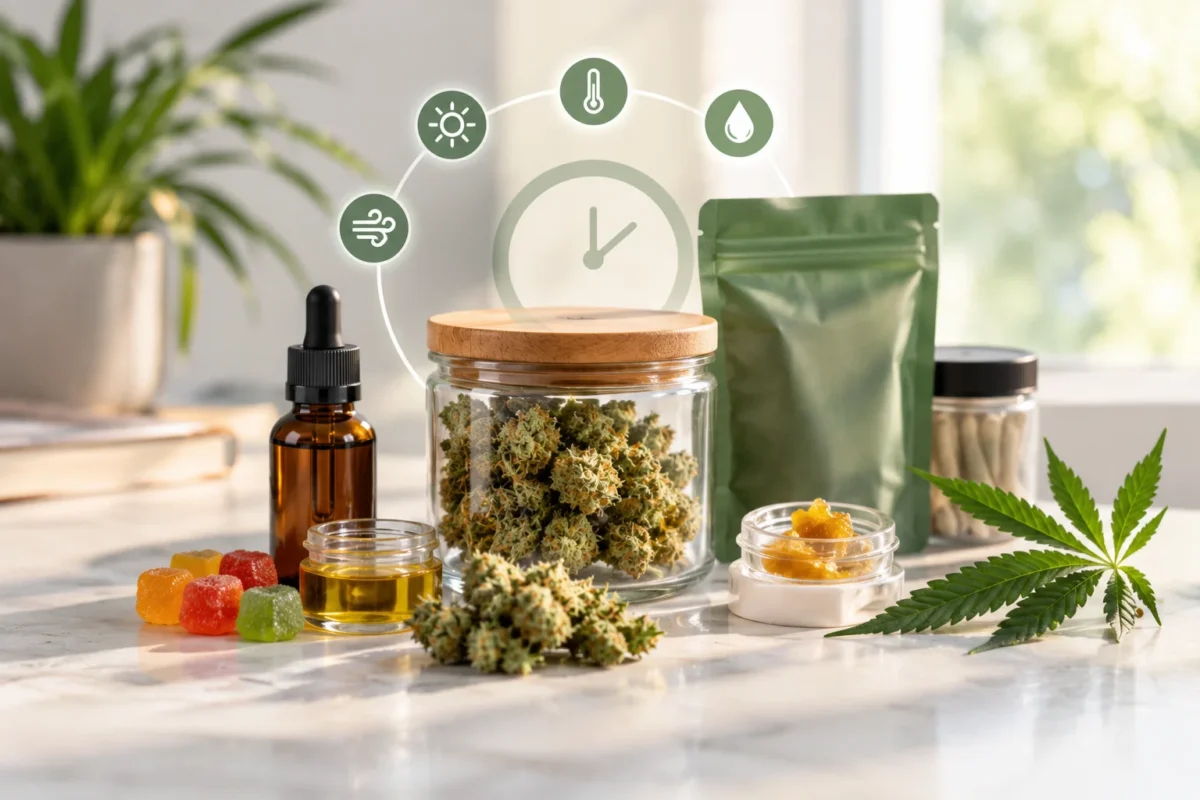
Short Answer:
The potency of cannabis products does diminish with time, but the speed of this degradation varies depending on the product itself, as well as on the packaging, temperatures, lighting, oxygen exposure, and humidity levels. According to studies, cannabinoids might be degraded during storage, especially THC.
Nevertheless, potency diminishment does not mean spoilage, and these two processes should not be confused. Potency might decrease without any visible changes to the product, whereas edibles or some other cannabis products might get spoiled due to the presence of food substances in them.
Get Your Medical Marijuana Card in San Diego
Have questions about medical cannabis? Get professional guidance from a licensed San Diego cannabis doctor through a simple online evaluation.
>>Start Your Evaluation Today<<
Why Do Cannabis Products Lose Potency?
Cannabinoids are chemicals that tend to degrade. When cannabis loses potency, it is due to the degradation of compounds such as THC and CBD, which is brought about by various environmental factors.
They include:
- Heat
- Light
- Oxygen
- Moisture
- Time
- Improper Packaging
Longitudinal research carried out on the effects of storing cannabis in different environments showed the degradation of THC, influenced both by light and heat. Formation of CBN was also noted while degrading THC.
This implies that the storage of cannabis goes beyond simply placing it in an accessible place because the environment influences the maintenance of its cannabinoid structure.
Does THC Expire?
THC doesn’t “expire” as in the case of food. Rather, the concentration of THC may slowly go down due to chemical alterations.
Tests conducted on dried cannabis under different temperatures from -20°C to +40°C showed that the cannabinoid decay could be estimated over time, proving that temperature is a crucial factor influencing the stability of cannabinoids.
One study conducted over a four-year period revealed considerable differences in THC and CBN content depending on the storage conditions. The samples stored in conditions of light exposure and room temperature showed especially significant differences during the study period.
Thus, the question whether cannabis products expire or lose their potency can be answered affirmatively, but there isn’t one expiration timeline for all types of cannabis products.
How Long Does Cannabis Stay Potent?
No one number fits the shelf life of all cannabis products.
A properly packaged flower product of cannabis can last much longer than flower cannabis which is exposed frequently to heating, light, and air.
This is true about all extracts, oils, capsules, candies, drinks, and other products, whose stability may differ very much due to different formulas.
The recently conducted stability study showed that stability depended on the type of cannabinoid, the type of product matrix, and storage temperature.
Cannabis Flower
The flower is especially vulnerable to poor storage due to the presence of many cannabinoids and plant components.
With prolonged exposure to inadequate storage, the flower might experience:
- Some decrease in cannabinoid content
- Acquisition of an unpleasant smell
- Excessively dry state
- Alteration in the cannabinoid content
- Mold growth under incorrect humidity
Studies have found that cannabis inflorescence is subject to alterations not only in cannabinoid content but also in volatile compounds involved in aroma generation.
Cannabis Edibles
Edibles are even more complex since other ingredients are added to cannabis.
Gummy, chocolate, cookie, drink, or any baked product may go through both alterations in its cannabinoid content and food ingredients. Thus, the “best by” or expiration date stated by the manufacturer should be considered seriously.
Regarding commercial products, follow the storage directions and the expiration date indicated on the packaging.
Cannabis Oils and Extracts
In addition, oils and extracts may go through the process of degradation as well. Studies have shown that stability of CBD can depend on factors such as temperature, oxygen, light, and formulation in which CBD is included.
Thus, this is one of the reasons why one can’t claim that all cannabis oils have the same shelf life.
What Causes the Fast Degradation of Cannabis?
In case you are wondering why some products degrade faster than others, storing them properly may be one of the reasons.
1. Temperature
Higher temperatures may accelerate the process of chemical degradation.
Research conducted on dried marijuana shows that there is a temperature dependence of the degradation of cannabinoids.
That is why storing marijuana in locations such as:
- Hot car
- Window sill
- Next to the heater
- Overheated room
is not recommended.
2. Light
The presence of light is yet another factor to consider.
According to older research on cannabinoid stability, light is one of the major factors causing cannabinoid degradation especially in cannabinoid solutions.
It has been also proven through tests that THC and CBN levels change significantly when marijuana is kept under light exposure.
3. Oxygen
Oxygen can cause oxidation and chemical reactions.
Repeated opening exposes cannabis to fresh air, which may slowly alter its components. Storing cannabis in the right containers, therefore, may prevent unnecessary contact.
4. Moisture
Moisture requires a separate discussion since this factor is not solely related to potency.
Excessive moisture provides good conditions for microbial growth. Conversely, too dry cannabis will lack smell and be harsh.
In view of this fact, the customers need to know that they cannot restore cannabis with visible signs of mold by drying it.
5. Time
Even with all necessary precautions, cannabinoids are not eternal in their stability.
Research on cannabis over several months or years shows that chemicals composition alters with time.
Correct storage will slow down this process but will not stop it.
How to Store Cannabis to Preserve Potency
If you want to slow the degradation of cannabis products, there are four key elements to consider: cool, dark, dry, and correctly packaged.
Keep Your Cannabis Out of the Light
This could mean storing your products in dark places or using packaging that protects against light exposure.
Never leave your cannabis exposed to sunlight on a countertop for prolonged periods.
Avoid Heat
Always follow the recommended storage temperature as stated by the manufacturer whenever possible.
Refrigeration may sometimes be recommended for some products. Temperature fluctuations and condensation may become an issue for other products. Remember that freezing doesn’t always help cannabis products.
Keep Packaging Sealed
Reduce unnecessary exposure to the air by always sealing your containers after using them.
For commercially packaged products, keep them in the packaging in which they were originally purchased because this packaging is tailored for the product.
Use Product-Specific Storage
Cannabis gummies and cannabis flower should not necessarily be stored in the same way.
Product-specific recommendations may be issued based on the product formulation and testing of stability.
In California, for example, cannabis products are required to have their best-by, sell-by, or expiration dates verified by retailers.
How Can You Tell if Your Cannabis Is
Potency loss is not always apparent. The pot can have less potency but show no observable physical change.
But there are a few characteristics that might lead you to reconsider using it.
Pay attention to:
- Visible mold growth
- Unexpected discoloration
- Foul smell
- Moisture
- Change in consistency
- Tainted packaging or any damage to packaging
- Product past expiration date by manufacturer
Mold is a health risk, not just a sign of lower potency cannabis.
Be careful assuming that just cutting off the tainted part will ensure the safety of the rest of the product.
When we are talking about edibles, do not forget that the food itself can become spoiled regardless of the cannabinoids. A THC-containing item does not necessarily mean a safe product.
Does THC Convert to CBN Over Time in Marijuana?
THC has the potential to break down into other chemicals, and one such chemical compound is CBN, a byproduct of THC breakdown.
There have been studies that prove increases in CBN along with reductions in THC for certain storage conditions.
It would be foolish, though, to consider aged cannabis as an automatic “THC to CBN converter.” Chemical reactions depend on conditions such as light, heat, oxygen, formulation, and time.
Hence, if there is loss of potency in cannabis-based products, don’t expect changes in effects in a certain predictable way.
Can Cannabis Products Be Potent After Aging?
Usually, one should not assume that the older a marijuana product gets, the stronger it will become.
There are some instances when certain cannabinoid measurements will be affected by time, but this does not mean that the product will become stronger as it is aged. Consumers are discouraged from using aging as a means of enhancing the potency of their products.
Does the Same Apply for CBD products?
CBD is also prone to chemical breakdown.
In one study exploring CBD stability, temperature, oxidation, light, and formulation were all shown to influence CBD stability. In this specific experiment, CBD was significantly more stable at 5°C compared to room temperature.
Further studies of CBD-containing e-liquids have also revealed degradation under high temperatures and light exposure.
This implies that the notion of loss of efficacy of cannabis products is not only applicable to THC-containing products but also CBD-containing products.
Should You Refrigerate Cannabis?
Not necessarily.
It is helpful to refrigerate some types of cannabis preparations especially those that require refrigeration according to manufacturer instructions. However, the refrigeration of all cannabis preparations is not always the optimal way forward.
This is because changes in temperature can result in condensation and certain cannabis products may change formulation when cooled.
The optimal course of action is to heed the manufacturer’s instructions for storage.
In terms of laboratory storage, studies have shown that lower temperatures are effective in preserving the cannabinoids. However, laboratory conditions are not always comparable to consumer storage conditions.
But what about Expired Cannabis?
An out-of-date cannabis product does not automatically equal an equivalent fresh cannabis product.
There are two distinct questions:
Has the cannabinoid profile changed?
Possibly.
Is the whole product safe for consumption?
It all depends on the product, ingredients, packaging, storage conditions, potential for contamination, and the recommendations of the manufacturer.
This becomes even more relevant when talking about edibles and beverages since other ingredients in such products could go bad independently.
When the product that is purchased commercially has gone past its marked expiration or best by date, then the safer course of action is to heed the advice of the manufacturer.
5 Simple Ways to Keep Cannabis Fresh
In order to prolong the shelf life of cannabis products, follow these helpful practices:
- Keep cannabis out of direct sunlight.
- Prevent exposure to excess heat and temperature fluctuations.
- Always seal the container properly after use.
- Prevent exposure of cannabis products to excess moisture.
- Adhere to manufacturer guidelines regarding storing and expiration of the product.
For regulated cannabis products, avoid removing the original labeling where possible. This may include valuable details regarding potency, ingredients, batch details, storage and expiration or best-by dates. The state of California has very detailed packaging and labeling laws for cannabis products.
Frequently Asked Questions
Does cannabis become less potent with age?
Yes. Studies indicate that cannabinoids like THC may be subject to degradation, and the conditions under which cannabis is stored can influence how quickly it happens.
How long is cannabis potent for?
There is no standard period after which cannabis becomes no longer potent. Various factors come into play.
Is old cannabis dangerous?
Not necessarily only from the loss of cannabinoid potency. Contamination, molds, spoiled food products used in cannabis production, damaged packaging, and expiration of commercially produced cannabis are potential dangers.
Does heat cause cannabis to lose potency?
Yes. Heat might accelerate the degradation of the compounds.
Closing Thoughts
Well, are cannabis products losing potency? Indeed, but the rate at which it happens varies.
Such factors as time, temperature, light exposure, oxygen presence, moisture, packaging type, and product formulation may affect cannabinoid stability. Many studies have already proved that THC and other cannabinoids can undergo transformation during storage, and new ones explore this issue on the example of different product formulas.
Resources
- Thermal Stability of Cannabinoids in Dried Cannabis: A Kinetic Study —
PubMed research paper - The Role of Time and Storage Conditions on the Composition of Hashish and Marijuana Samples: A Four-Year Study —
PubMed research paper - The Stability of Cannabis and Its Preparations on Storage —
PubMed research paper - Stability of Cannabinoids in Cannabis: Plant Material, Extracts, Oil Formulations, and Isolates —
PubMed research paper