Short answer:
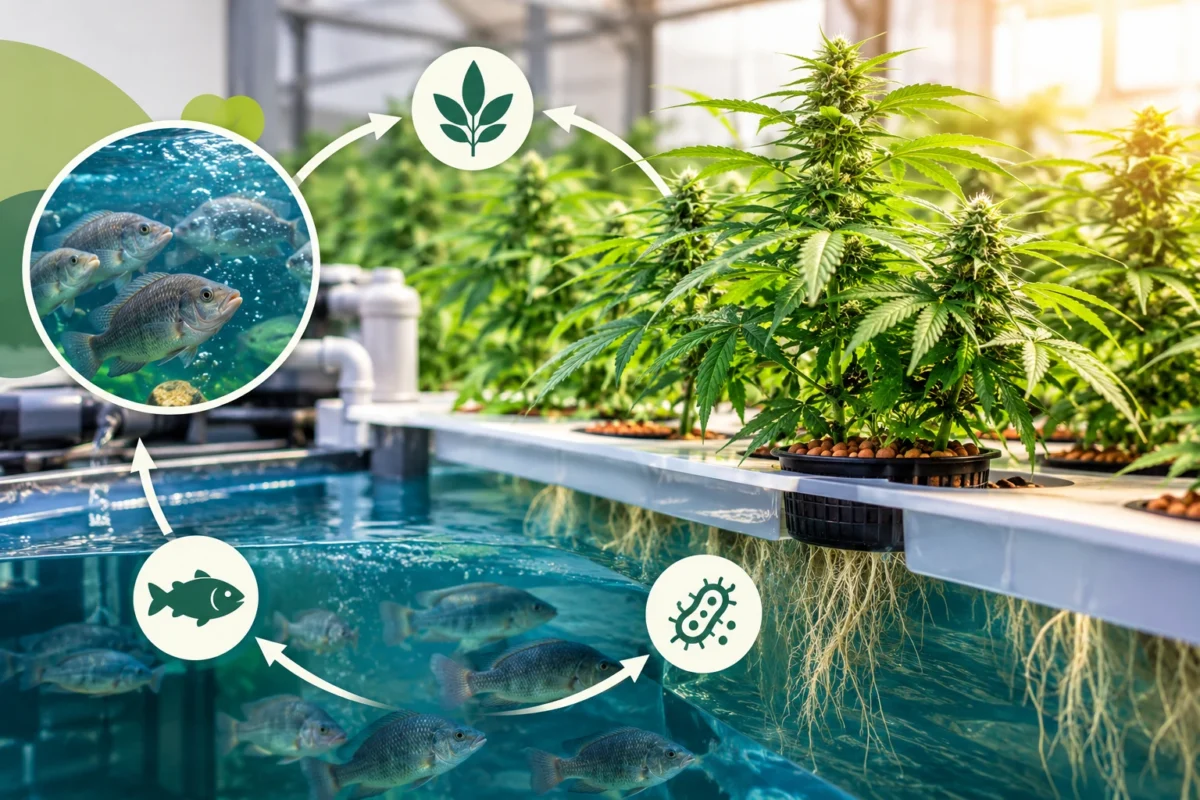
Aquaponic Cannabis is a process where cannabis is grown using an aquaponics system whereby plants are grown without any soil while at the same time raising fish in a closed system environment. The waste from fish contains nutrients for plants that get converted into plant-friendly form by bacteria, and plants get rid of excess nutrients in the circulated water.
What would happen if a fish farm could simultaneously cultivate healthy crops? This is the premise behind aquaponics, a modern agricultural technique which incorporates fish, plants, water and beneficial bacteria into a single system.
Soil-based cannabis growing requires soil, fertilization, irrigation and expensive equipment. Hydroponics gives an alternative to soil cultivation by growing plants without using soil. Aquaponics provides yet another step to hydroponics by integrating the growing process of fish and plants.
Aquaponic growing of cannabis is part of a bigger discussion about sustainable agriculture and resource optimization. Rather than having fish waste disposed of because of being considered useless, a well-designed system can make use of nutrients contained in this waste.
Nonetheless, aquaponics is not a cure-all technique. The requirements for fish and plants differ, as well as the requirements for the overall system. Learning how it operates sheds light on its possibilities and difficulties.
What Is Aquaponic Cannabis?
Aquaponics is a practice that integrates aquaculture (cultivation of aquatic animals such as fish) and hydroponics (cultivation of plants using no soil).
In conventional aquaponics systems, water flows between a fish tank and a plant production site. The fish create excrements containing nutrients. Good bacteria process most of the excrements and transform ammonia to nitrite and nitrate. Growing plants uptake the available nutrients while the water returns to the fish tank.
This way an integrated system is created where three components are necessary for success:
- Fish: Produce excrements with nutrients.
- Bacteria: Transform nitrogen compounds to usable forms.
- Plants: Uptake nutrients from the water.
According to the Food and Agriculture Organization of the United Nations (FAO), aquaponics depends on the balance between fish, plants, bacteria, and water parameters. All the components influence each other, therefore the whole system needs to be monitored.
How Does an Aquaponics System Work?
One of the fundamental concepts of an aquaponic cannabis system is nutrient recycling. In an aquaponic system, nutrients are not obtained from an external fertilizer preparation; nutrients are generated inside the fish cultivation tank.
The waste product from the fish gets into the water, where waste products get broken down by microorganisms, and the nitrogenous compounds are converted. The biofilter or growing media is the place where the beneficial bacteria thrive. The roots of plants absorb the nutrients from the water when it flows through the planting section.
The water goes back to the fish tank again, even though other components are necessary for proper functioning of the system.
Aquaponic systems have several designs. There are media bed aquaponic systems where the roots of the plants grow in a medium that supports their growth. Another example is the deep-water culture aquaponic system where the roots of the plants hang in oxygen-rich water. Nutrient film technique aquaponic systems use a flow of water through the channels.
What Are the Potential Benefits of Aquaponic Cannabis?
Another factor influencing cultivators to experiment with aquaponic cannabis is the potential for efficient water and nutrient use. Nonetheless, real-life outcomes may vary based on the design of the system, energy consumption, climate conditions, and management.
- Nutrient cycling: Nutrients from fish waste can supply part of the requirements for growing plants, limiting the necessity for external fertilizer application.
- Water cycling: Water can cycle throughout the system instead of being used once and discarded.
- Multifunctionality: The right system can produce both plants and fish in one unit.
- Reduced need for soil: Plants do not require garden soil to grow, which may be valuable in certain controlled environments.
- Potential waste minimization: Combined fish and plant production systems may generate less nutrient discharge than poorly run separate systems.
According to the FAO, aquaponics can allow for nutrient cycling and minimizing discharge of aquaculture effluent into the surrounding environment in properly designed and run systems. Here is the FAO’s brief overview of aquaponics as an integrated production system.
What Issues Should Growers Be Concerned About?
Despite the seeming simplicity of aquaponic cannabis, maintaining an alive system can be quite difficult. Fish, plants, and bacteria require similar environmental conditions, and a problem in one part can lead to an overall disruption.
Water composition should be taken into account. Such factors as temperature, pH, dissolved oxygen, and nitrogen compounds affect the condition of fish, bacteria, and plants. High amounts of ammonia and nitrite are toxic for fish, and inappropriate pH can limit access to nutrients for plants.
Also, it is necessary to consider the reliability of the equipment. Devices that ensure constant water flow and oxygenation can break down due to a power outage or malfunction and cause aquatic animals’ death. Backup plans should be made.
Finally, initial expenses might be greater than expected. Such elements as tanks, water testing equipment, pumps, and back-up systems should be bought. At the same time, growers should know how to care about fish and provide proper nutrition for plants.
Is Aquaponics Growing of Cannabis More Sustainable Than Regular Farming?
It all depends on how well the system is designed and operated. There are several potential sustainability benefits that come from nutrient and water reuse in aquaponics, but it does not guarantee that every system is environmentally friendly.
For instance, a facility with intensive electricity consumption for lighting, heating, cooling, and water pumping has a large carbon footprint. The fish food and its production make another contribution to the environmental impact of the farm.
For a proper comparison, the following parameters should be taken into account:
- The total volume of water and water losses.
- Electricity consumption for lighting, pumps, and climate control.
- The quantity of additional fertilizers and materials.
- Fish wellbeing, their feed, and waste treatment.
- The yield and the longevity of equipment.
These principles of good system operation are underlined by the FAO recommendations about aquaponics.
Safety and Legal Issues
One should investigate the legislation related to cannabis growth in their jurisdiction when they decide to conduct aquaponics research on cannabis plant. This includes such aspects as licensing, allowable amount of plants and other restrictions.
Water and equipment sanitation are the issues which require attention too. Fish need a proper condition in the water and plants should be grown under sanitary conditions too.
If a person intends to use his crop for medical purposes, it should be noted that cultivation techniques do not define whether the product is safe and efficient or not.
Frequently Asked Questions
What is aquaponic cannabis?
Aquaponic cannabis means growing cannabis alongside fish farming. Beneficial bacteria change fish waste into nutrients that plants can take through water circulation.
Does aquaponics utilize fish waste as fertilizer?
Yes. Fish waste provides nutrients to the system, and beneficial bacteria transform nitrogen compounds into plant-friendly ones. However, nutrient levels should be controlled.
Does aquaponics save water?
Recirculating aquaponics system might use less water than some systems that regularly drain water. The actual amount depends on evaporation, plant needs, maintenance, leakage, etc.
Is aquaponic cannabis easy to grow?
No. Aquaponics involves understanding of plant requirements, fish requirements, beneficial bacteria, filtration, water chemistry, and many other factors. Any equipment failure might influence the whole system.
Is aquaponics always environmentally friendly?
No. Although aquaponics might increase nutrient recycling and water usage, it might consume electricity, fish food, equipment, and other resources.
Conclusion
Aquaponics for cannabis production presents an intriguing approach to linking fish farming and plant cultivation using the recycling of nutrients and water. There are possible sustainable benefits to this method, but it requires that there is balance in water chemistry, healthy fish, beneficial bacteria, good equipment, and proper resource management. It is important to know both the pros and cons before adopting the technique.
Interested in Medical Cannabis?
Looking for reliable guidance on medical cannabis? Our team can help you understand the medical cannabis card process and explore whether you may qualify.
>>Get Your Medical Marijuana Card<<
Sources
- Food and Agriculture Organization of the United Nations. Small-Scale Aquaponic Food Production: Integrated Fish and Plant Farming.
- Food and Agriculture Organization of the United Nations. Seven Rules of Thumb to Follow in Aquaponics.
- Food and Agriculture Organization of the United Nations. Aquaponics: Integrated Aquaculture and Hydroponics Systems.
- Veriheal. Growing Cannabis “Aquaponically”: Good for Fish, Consumers, and Earth.