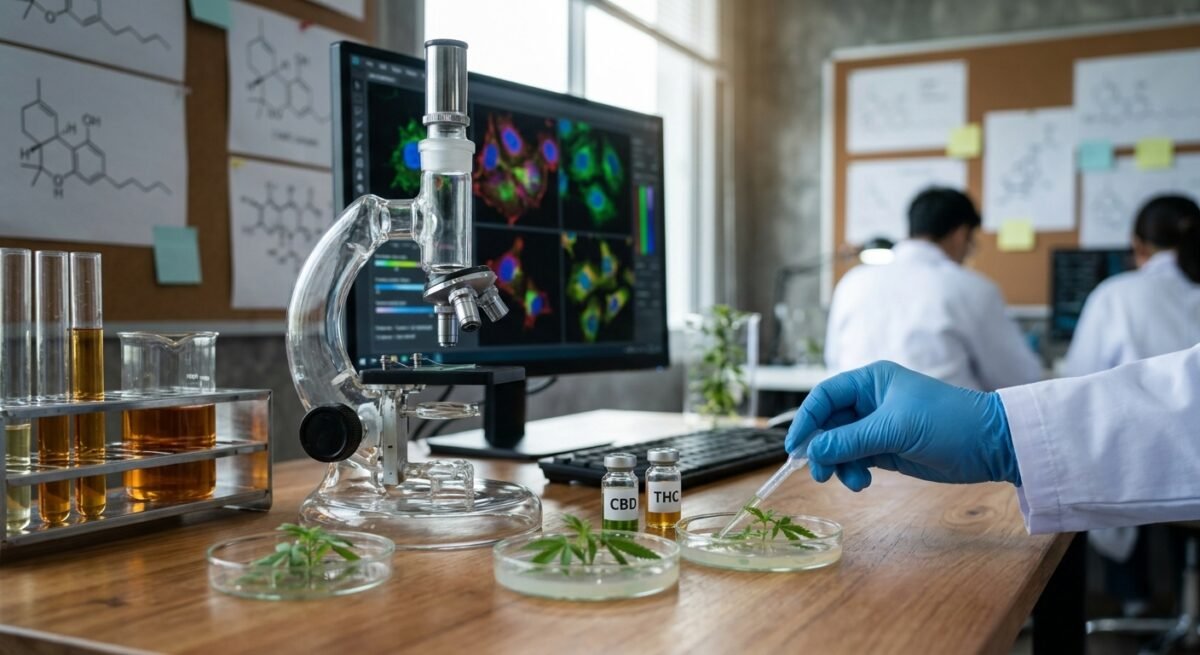
The interaction between cannabis and prostate cancer is another subject of scientific investigation that has yet to be fully developed.
Scientists are researching the effects of various cannabinoids, including CBD and THC, on interactions with prostate cancer cells. Most studies were conducted in vitro or in animal models, rather than in humans.
The difference is significant.
The fact that a substance is proven to inhibit cancer cells development in a laboratory test is not sufficient for its successful use in a human treatment. For the treatment method to become one of the standard methods, scientists need clinical studies in humans.
Nowadays, conventional prostate cancer treatments continue to form the basis of treatment. It includes active surveillance, surgery, radiation therapy, hormone therapy, chemotherapy, immunotherapy, and targeted treatments depending on cancer type.
The Reasons Behind Using Cannabis in Prostate Cancer Treatment
Cannabis has many biologically active components known as cannabinoids. THC and CBD are among the most widely recognized ones.
The mechanisms of cannabinoid interaction with biological processes like inflammation, cellular communication, pain, and immunity are being studied.
Researchers wonder if it could be used in studying the mechanisms of cancer someday.
A few scientific works mentioned the ability of cannabinoids to impact the development of prostate cancer cells through the processes of cell proliferation, migration, survival, and cell death. A systematic review of studies conducted on animals also showed that cannabinoids reduced the size of tumors in prostate cancer experimental models. However, this systematic review was based on only a few animal studies, which makes these results not directly applicable to the human case.
This explains why the topic remains interesting but requires caution.
Research About CBD Effects
There have been many efforts made to examine CBD due to its lack of the intoxication properties of THC.
A number of studies were performed to see if CBD can influence the prostate cancer cells.
First of all, a laboratory study carried out in 2023 showed that CBD decreases viability and proliferation of prostate cancer cells. Moreover, some changes were noted in proteins responsible for the cell-cycle regulation and AKT signaling.
Moreover, another study conducted in the same year studied CBD on PC3 prostate cancer cells. It was shown that there is a decreased cell viability and apoptosis induction.
Such discoveries are important since uncontrolled cell division is a defining feature of any cancer disease.
Nevertheless, these experiments used cancer cells in a laboratory setting. Therefore, there is no evidence showing that CBD can treat prostate cancer in people.
Moreover, other studies examined CBD in a more complex prostate cancer model. For example, in 2024, there was published a study demonstrating that CBD influences pathways connected with metastatic castration-resistant prostate cancer and reduces the tumor progression in animal models.
Such discoveries increased scientific interest in CBD, however, human trials are required.
THC in Research
THC is one of the cannabinoids that is most often linked to the intoxication caused by cannabis use.
Scientists have researched THC and artificial cannabinoids in cases of prostate cancer for many years.
One of the first studies in the lab showed how THC can initiate apoptosis in PC3 human prostate cancer cells.
Modern scientific research has also been focused on the effect of the receptor pathway of cannabinoids. Thus, scientists working on the artificial cannabinoid WIN 55,212-2 reported reduced proliferation, migration, invasion, and growth of prostate cancer in experimental models. They established that the CB2 receptor is involved in some of these effects.
Of course, the described findings should be considered as scientific signals but not a guarantee of the cancer treatment.
Artificial cannabinoids used in scientific research can also act differently from those cannabis preparations available for purchase in stores. Dose, preparation form, absorption rate, concentration of cannabinoids, and other variables can change biological activity.
Can Cannabis Help with Cancer Symptoms?
This is where cannabis has its research more clearly delineated.
Cancer and cancer treatment therapies can lead to pain, nausea, vomiting, appetite loss, fatigue, and insomnia. According to the National Cancer Institute, cannabis and cannabinoids have been investigated for treating certain cancer symptoms and treatment side effects.
For instance, the FDA approved the use of two cannabis-based drugs, dronabinol and nabilone, for certain cases of chemotherapy-induced nausea and vomiting. This is distinct from being approved as a cancer treatment.
Similarly, according to the American Cancer Society, cannabis may play a supporting role in managing certain cancer symptoms but not as a treatment or cure.
Management of symptoms may very well be an important aspect of general care for prostate cancer sufferers.
Pain becomes more relevant especially if the prostate cancer has metastasized to other sites such as the bones. NCI mentions several proven treatments for bone pain caused by prostate cancer, including pain medication, radiation therapy and other medical treatment options.
Cannabis should be taken into consideration, if applicable, as a support measure and not as a replacement of established cancer treatment.
What the Research Still Cannot Tell Us
There is a significant difference between research in the lab and evidence in the clinic.
Currently, there is insufficient human evidence in order for researchers to conclude that cannabis, CBD, or THC can:
- Heal prostate cancer
- Replace surgery or radiation
- Replace hormone therapy
- Prevent prostate cancer from coming back
- Halt the metastasis of prostate cancer
- Improve survival
- Consistently reduce prostate tumors in patients
According to the National Cancer Institute, the FDA has not approved any form of cannabis or cannabinoids for cancer treatment.
It does not mean that research is over.
On the contrary, it means that researchers need better clinical evidence in order to see what cannabinoid types, dosages, formulations, and combinations may work for some patients.
Safety and Potential Drug Interaction
Natural does not automatically translate into being free of risk.
Cannabis has potential side effects and THC might influence memory, focus, coordination, and judgment. There could be other considerations depending on the product used, dosage, route of intake, and personal reactions to it.
Prescription medicine interaction could also be a consideration.
NCI states that cannabinoids can interact with the human body’s cytochrome P450 enzyme system. Specifically, CBD can affect certain enzymes responsible for metabolizing some medicines which could lead to change in their concentrations.
It is important to take into account for people undergoing cancer therapy since prostate cancer treatments can include several prescription drugs.
For instance, hormonal therapy can have side effects like fatigue, changes in sexuality, hot flashes, reduced bone density, and changes in the patient’s mood.
Anybody who is planning to use cannabis during cancer therapy should discuss it with their oncologist, urologist, pharmacist, or any other qualified healthcare practitioner.
Issues to Be Discussed by the Patient with the Doctor
If you are weighing the pros and cons of including cannabis in your prostate cancer care regimen, an honest discussion with your doctors and other health-care providers will allow you to minimize unnecessary risks.
Examples of such discussions could include:
- Can cannabis cause interactions with my medication?
- Is the medicine I am taking processed via CBD or THC pathways?
- Will cannabis have an impact on my cancer treatment?
- What symptoms am I addressing with cannabis?
- What alternatives do I have that might be more safe?
- Which formulation of cannabis will bring least risks?
- When should I stop taking it because of warning signs?
- Is there anything special my treatment provider should watch for?
It is particularly important to inform your medical treatment provider about it in case you are undergoing chemo, hormone therapy, immunotherapy, radiotherapy, or any other cancer treatment.
Moreover, the National Cancer Institute warns that certain complementary treatments may have negative impact on conventional cancer treatment, and therefore you should discuss cannabis with your provider instead of using it independently.
The Future of Cannabis and Prostate Cancer Research
The science of cannabis and prostate cancer is becoming increasingly complex.
Scientists are no longer merely seeking answers regarding whether cannabinoids have an effect on cancerous cells. Scientists are looking at pathways, combinations of cannabinoids, combination therapies, and different kinds of prostate cancers.
In fact, recent research in the lab has explored whether CBD would augment the efficacy of certain anticancer drugs. One study from 2025 revealed that CBD would improve the anticancer activity of etoposide in prostate cancer cell models.
It is an intriguing area, but one that remains experimental at this point.
Future trials will address many more practical questions:
- Does a cannabinoid deliver any benefits in humans?
- Who can benefit?
- What is an appropriate dose?
- Which cannabinoid is best?
- Are cannabinoids safe to combine with other treatments?
- Do the benefits outweigh the risks?
- How do cannabinoid-based medications impact cancer progression or
- treatment?
Until all these questions are addressed, it is best to characterize cannabis as an area for research rather than a proven prostate cancer treatment.
Conclusion
Studies conducted on cannabis and prostate cancer have generated some positive results in experiments and animals, especially with CBD and other cannabinoids.
The effects of cannabis have been seen to have an impact on the growth, invasion, apoptosis, and tumor formation in prostate cancer cells.
But there is a distinction between scientific studies and a proven treatment option.
In the case of someone with a prostate cancer diagnosis, cancer treatment based on scientific evidence is important. Cannabis might have the potential to help with some symptoms for some patients, but it cannot be a substitute for the actual treatment.
For someone interested in using cannabis while receiving treatment for prostate cancer, consulting one’s doctors is important. One can have a personal discussion regarding the benefits, side effects, interaction with medications, and overall treatment plan.