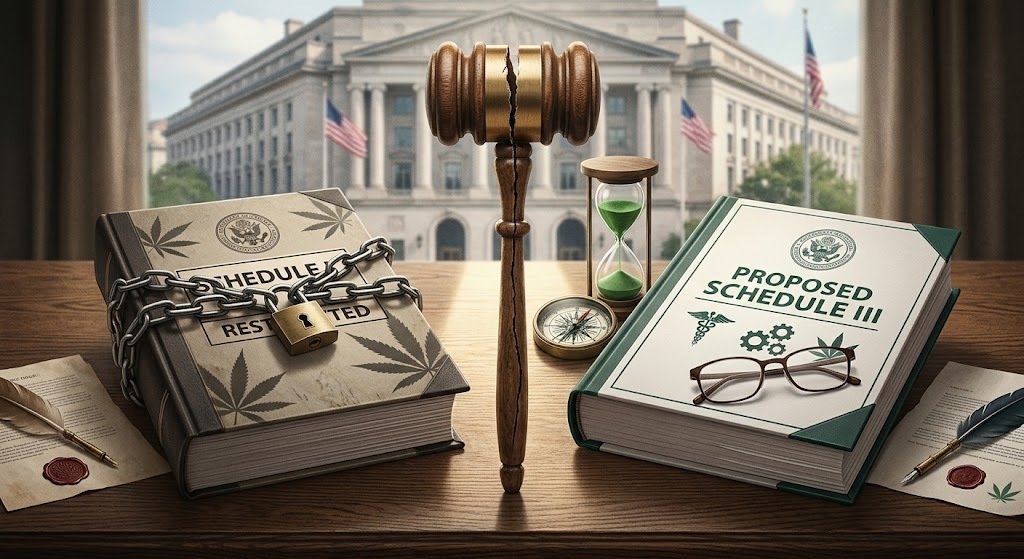
Cannabis rescheduling has long been seen as one of the most significant potential policy changes for federal marijuana legislation. This process has come a long way since the first proposal for it was initially introduced.
In April 2026, the U.S. Department of Justice made a very notable distinction. FDA-approved cannabis products and cannabis products regulated by qualifying state medical marijuana licenses were put on the Schedule III under the Controlled Substances Act, and, at the same time, DEA has initiated an accelerated process of considering rescheduling of marijuana from Schedule I to Schedule III.
This is an important distinction to make.
While the U.S. federal government did not schedule all marijuana as Schedule III, some marijuana products and state medical marijuana became Schedule III, while the issue of scheduling remained within the context of formal rulemaking.
The latest developments in the process have certainly gone far beyond the silence of the initial coverage of the process. Thus, in August 2026, the DEA and other participants submitted their final briefs after the extensive administrative hearing.
So, what is the status of cannabis rescheduling now?
The short answer is: the federal government has achieved something significant, but not everything yet.
Reasons Behind the Delay in the DEA Process
Rescheduling of cannabis cannot simply be defined as the process where the agency changes the category of the substance.
According to the Controlled Substances Act, rescheduling a controlled substance requires a legal and administrative procedure.
In 2024, the Department of Justice has first suggested to reclassify marijuana from Schedule I to Schedule III. The decision was based on medical and scientific considerations of the Department of Health and Human Services (HHS).
The matter was made difficult due to disagreement about the criteria that the federal law should use to determine if there is currently accepted medical use of cannabis.
The opinion of the Department of Justice’s Office of Legal Counsel of 2024 has stated that the previous interpretation by DEA was too narrow. An alternative framework for establishing accepted medical use had been proposed by HHS.
What Was the Outcome of the Latest DEA Hearing
The process of the hearing was initiated anew by the federal government in 2026, since it withdrew from the previous hearings.
According to the department of justice, the previous hearing was withdrawn to allow the DEA to initiate a new hearing in order to streamline the whole process of rulemaking. The new hearing was supposed to begin on June 29, 2026.
It took 11 days before the end of the hearing, which concluded on July 15.
In the course of the hearing, witnesses and lawyers were discussing such issues as medical usage, scientific research, possibility of abuse, dependency, and whether marijuana fulfills all the criteria of Schedule III.
Following that, the DEA filed its final brief arguing that marijuana needs to be reclassified from Schedule I.
Then in August, all the parties presented their final briefs following the hearing, leaving everything to be recommended by the administrative law judge.
At the same time, the official transcript is still being prepared. An August 2026 order by the DEA’s chief administrative law judge instructed corrections to the transcript to be made public.
How Schedule III Rescheduling Might Change Things
If rescheduling of cannabis happens to be enacted, there will be considerable changes for the cannabis industry.
While Schedule III drugs and Schedule I drugs are different under federal laws, such a move might relieve some of the issues associated with regulations and costs that are facing cannabis companies since marijuana has always been classified as Schedule I drug.
The first one is taxation.
Since a while now, the businesses that deal with marijuana have been facing difficulties caused by the tax code called 280E of the Internal Revenue Code. According to this code, a business dealing with Schedule I and Schedule II controlled substances cannot take any deductions.
Thus, moving marijuana to Schedule III will allow certain businesses to become exempt from 280E and make them take ordinary deductions.
It will definitely change the way the regulated cannabis industry works financially.
But such a step will not legalize cannabis throughout the country.
What Cannabis Rescheduling Will Not Accomplish
This is one of the most critical aspects for the consumer to realize.
Cannabis rescheduling is not equivalent to the federal legalization of marijuana.
Even after rescheduling to Schedule III, cannabis will still be a controlled substance under federal law.
The Department of Justice’s initial proposed rule actually specified that rescheduling cannabis to Schedule III will not do away with the criminal prohibitions against the manufacture, distribution, dispensing, or possession of marijuana.
What this means is that one cannot expect rescheduling cannabis to make it suddenly legal wherever one goes.
State laws will still have relevance.
Medical marijuana programs, adult-use markets, limits on possession, workplace rules, drug testing requirements, driving laws, and other regulatory mechanisms can vary from state to state.
As a consumer, the best thing to do is to stick with whatever the cannabis laws in your state say.
Why Research Could Be Benefited from Rescheduling
Cannabis rescheduling is important to research as well.
For many years, scientists and researchers had difficulties with conducting studies on cannabis due to federal regulations.
Recently, the government’s actions directly point towards expansion of research in medical cannabis sphere.
As the U.S. Department of Justice noted, one of the goals of the April 2026 regulation was to stimulate the research on the safety and efficacy of cannabis treatments.
The research in the future could give a better evidence to patients, physicians, legislators, and researchers.
It can help to solve practical issues that remain unanswered such as:
- What conditions might respond best to cannabis treatments?
- What type of cannabinoid would be more efficient?
- What are the right doses for certain patients?
- What is the interaction between cannabis and other drugs?
- What are the dangers of constant consumption?
- Which patients should not take cannabis?
Those are important issues, which require further research.
How It Could Affect Medical Cannabis Patients
This potential development could result in a more consistent situation in the long run, but for now, it may not have as much of an effect as what some of the news stories might indicate.
Medical marijuana programs at the state level will still matter since there is still a strong connection between cannabis access and state law.
Medical marijuana patients should make sure that they check their state’s program guidelines rather than assuming that the new schedule means anything with regard to their qualifications or purchasing cannabis.
If you are looking into becoming a medical cannabis patient, you can look at information on medical marijuana evaluations from Veriheal or its medical marijuana qualification test.
What Comes Next
The next major step is that of the administrative law judge’s recommendation based on the hearing and post-hearing briefs completed.
The recommendation itself will be significant, but it will not necessarily mark the end of the discussion.
There are further legal and administrative processes involved in rescheduling under the federal rulemaking process.
There will also likely be further discussion about the ways in which the substance might be included in Schedule III and what further federal regulations might apply to it.
The April 2026 action is one example of the complexity of this transition process. The government has been able to place some FDA-approved products and qualifying state-licensed medical marijuana products into Schedule III, even while working on the other issue of marijuana in general.
This shows that there is currently a transitional time for the cannabis industry.
Why the Discussion Is Important Outside of Washington
Rescheduling is about much more than a mere federal classification.
It can affect research, taxation, business practices, medical progress, and the perception of cannabis for future policymaking.
On the other hand, the consumer must be aware of the potential overstatements regarding the instant solution to all the problems in the cannabis market through rescheduling.
It will not do.
Schedule III will still have cannabis under federal control, while state laws will retain their significance.
The best approach to the present scenario is to treat it as an important move in the realm of federal cannabis policy.
Resources
- U.S. Department of Justice — Cannabis rescheduling announcement — https://www.justice.gov/opa/pr/justice-department-places-fda-approved-marijuana-products-and-products-containing-marijuana
- Federal Register — Marijuana rescheduling proposal — https://www.federalregister.gov/
- DOJ Office of Legal Counsel — Marijuana rescheduling opinion — https://www.justice.gov/olc/opinion/questions-related-potential-rescheduling-marijuana