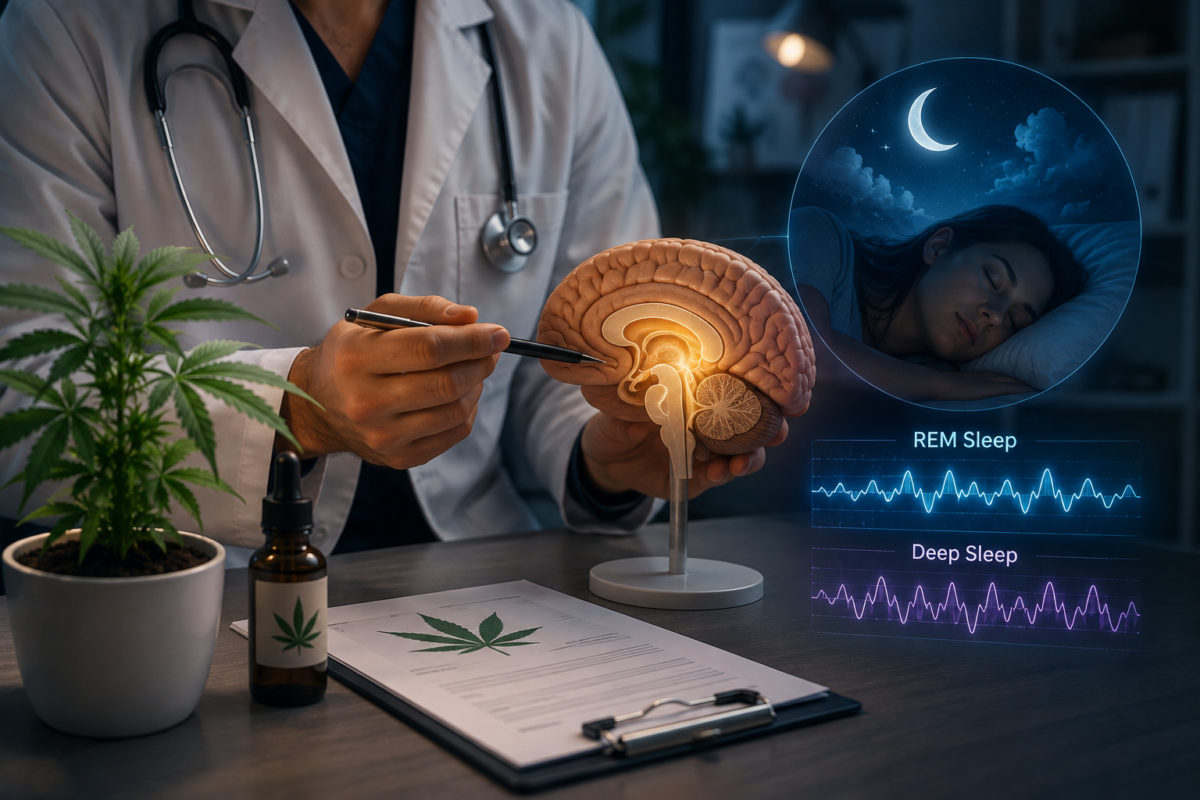
Knowing about REM Sleep and Dreams
Sleep is not an uninterrupted process. As the night goes on, the brain cycles through different phases of sleep, which include non-REM sleep and rapid eye movement (REM) sleep.
Cannabis and REM sleep is very closely linked to the occurrence of dreams, but dreams may also happen in non-REM sleep. This is relevant because nightmares are not just a “REM-only” issue.
Nightmare studies have proven that disturbing dreams may come during different sleep phases, especially when someone is having trouble sleeping due to trauma.
It makes the connection between cannabis and REM sleep more complicated than the statement that the less REM, the fewer nightmares.
Cannabis and REM Sleep: What the Evidence Reveals
There are many cannabinoids in cannabis, but THC tends to be where the bulk of the research is focused in relation to sleep.
Some early studies have indicated that cannabis has the ability to affect sleep architecture, as well as REM processes. But there has yet to be an agreement in research regarding the exact effect of cannabis on all stages of sleep for everyone.
One review of cannabis and sleep literature found mixed results and that more controlled and longitudinal research needs to be done.
Recent evidence also suggests the need for caution. In 2025, a systematic review and meta-analysis of cannabis use found that observational studies found current use associated with poor sleep quality and insomnia symptoms as well as irregular sleep duration. But experimental studies did not show this same relationship.
That is significant.
It means that cannabis and REM sleep experiences may vary according to such things as:
- THC content
- CBD content
- Frequency of use
- Time of use
- Personal tolerance
- Sleep disorders
- Other medications or substances
- Chronic pain or PTSD and other conditions
How THC May Influence Dream Recall
The reduced frequency of dreams reported by people who use cannabis may not be because they stop dreaming altogether.
A person might just recall fewer dreams.
Dream recall also involves awakening from the dream or right after it.
If there are any changes in sleep patterns as a result of cannabis use, this could lead to an observable change in dream recall frequency.
And this could be perceived as the effects of cannabis being the removal of the dreams.
However, reduced dream recall does not necessarily translate to better sleep.
A person might experience increased sleep duration but still have low-quality or poor sleep.
Alternatively, a person might dream a lot but not necessarily have a sleep disorder.
This aspect is particularly important when discussing cannabis and REM sleep.
Can Cannabis Treat Nightmares?
It is here that things start to get really interesting.
A few studies have looked at cannabinoids for nightmares caused by traumas, such as nightmares related to post-traumatic stress disorder (PTSD).
In one very small randomized controlled trial, nabilone, which is an artificial cannabinoid, was evaluated in the context of patients with PTSD and nightmare disorder. The sample size was only ten patients. The researchers found a higher reduction in nightmare symptoms among nabilone users compared to the placebo group.
But of course, a study based on ten people can hardly confirm that cannabinoids work for everybody.
Moreover, another review concluded that the data on cannabinoids and PTSD is rather limited, as many of the studies are flawed.
Thus, even though the results are interesting, they should not be turned into a guarantee that cannabis will eliminate nightmares.
Does Cannabis Cure Nightmares?
This is where it gets really interesting.
There are studies which have been performed on the efficacy of cannabinoids to treat trauma-associated nightmares or nightmares associated with post-traumatic stress disorder (PTSD).
For example, one randomized controlled study was performed with nabilone, which is an artificial cannabinoid used in individuals with PTSD and chronic nightmares. There were ten patients in total who took part in the study. They found that there was a better reduction in nightmare symptoms with the use of nabilone rather than with the placebo group.
However, it is not appropriate to generalize from a study where there were only 10 participants.
Another review concluded that there is insufficient data with respect to cannabinoids in PTSD patients.
Although this is fascinating, we mustn’t make any promises regarding the effectiveness of cannabis.
THC and CBD: Not Exactly Interchangeable When It Comes to Sleep
THC is intoxicating and may impact alertness, memory, sleep habits, and dreaming.
CBD does not share the same intoxicating quality with THC and has been studied for its possible effect on various sleep components and anxiety.
Yet, the link between CBD and sleep has yet to become evident.
According to the National Center for Complementary and Integrative Health, studies involving cannabis and cannabinoids have shown improvement in sleep in some medical conditions, but it cannot be said for sure if it is the cannabis that helps with sleep or if the patient sleeps better as another issue gets solved.
Why Cannabis May Also Disrupt Sleep
This is because people can easily concentrate on the potential advantages alone.
Consumption of cannabis regularly does not ensure a good night’s sleep.
A recent systematic review reported the links between the consumption of recreational cannabis and poor sleep quality, symptoms of insomnia, and inconsistent sleep time in observational studies.
Researchers must also consider the likelihood of individuals with sleeping problems consuming cannabis.
This means that cannabis may be:
A cause, a reaction, or simply a component of a broader issue concerning sleep.
This is why individual experiences vary greatly.
An individual may find that cannabis helps him/her sleep, while another one might feel drowsy and experience disruption in his/her usual sleep cycle or dreaming pattern.
What Occurs in Frequent Cannabis Consumers when They Cease Usage?
Some regular cannabis consumers claim to experience extremely vivid dreams when they stop using cannabis.
This phenomenon is referred to as “REM rebound,” although it is a more complicated issue than the name suggests.
The symptoms of cannabis withdrawal include insomnia, strange dreams, irritability, and irregularities in sleeping patterns.
Again, this is another point where one should not automatically conclude that altering dreams is always helpful.
Dreaming is a natural component of sleep, and dream alteration does not necessarily mean correcting any sleep disorder.
How Can Sleep Disorders Be Treated Safely?
Nightmares that occur once in a while might not need any kind of treatment.
However, recurring nightmares need special consideration, especially if they:
- Keep disturbing your sleep
- Make you scared to fall asleep
- Interfere with your focus on work
- Appear after a terrible experience
- Persist for many weeks or even months
- Are accompanied by serious anxiety or PTSD symptoms
If one experiences recurring nightmares, there are a few options for treatment that have been proven effective and should be discussed with an experienced doctor.
Guidelines about different types of treatment for nightmare disorder were developed by the American Academy of Sleep Medicine and include psychological and pharmacological interventions.
As far as PTSD is concerned, the U.S. Department of Veterans Affairs has pointed out that, according to recent VA/DoD clinical practice guidelines, cannabis or cannabis preparations cannot be used to treat PTSD due to lack of evidence.
What Medical Cannabis Card Sandiego Can Do For You
If you are thinking about trying medical cannabis, it is first important to understand the rules for your area and consult the right healthcare provider.
Medical Cannabis Card Sandiego can assist qualified patients in processing the medical cannabis card application and getting expert advice prior to making a decision to use cannabis.
In case someone is interested in cannabis for sleep problems, a visit to the doctor may become a good chance to talk about current medication and potential risks, etc.
You can also check additional information provided on our website about medical cannabis cards, San Diego medical card services, and cannabis consultations.
Conclusion: Cannabis and REM Sleep
The link between cannabis and REM sleep is much more complex than the notion that cannabis “disables dreams.”
THC could affect sleep and dreaming processes, and some cannabinoid-based therapies have demonstrated certain promise in helping with nightmares related to traumatic experiences. But the evidence available is still relatively weak, particularly in the case of cannabis.
Moreover, there is scientific evidence that cannabis consumption is linked to poor sleep results, while clinical trials have occasionally found mild benefits of cannabis among certain patient groups.
Thus, cannabis should not be viewed as a solution to nightmare problems, but rather as a subject of active research.
If nightmares occur frequently and are related to traumatic experiences, anxiety or any other health problem, professional assistance would be the right approach to take.